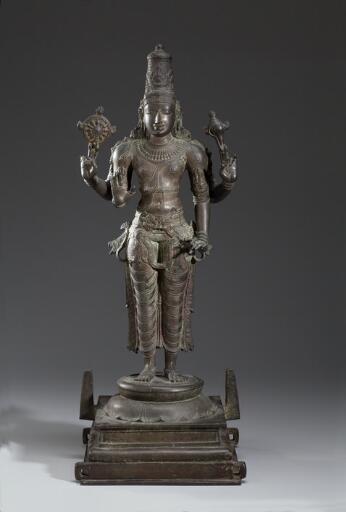
Vishnu, 13th century
Indian
The Cholas originated a tradition of large-scale, cast-metal Hindu sculpture in the round. These sculptures were carried in ritual processions through the temple and adjoining precincts––the lugs and holes on the base were used for the insertion of poles to support the image. As icons of worship, Hindu sculptures were believed to be concrete forms in which the Hindu gods temporarily resided. Because of their religious function, every feature of these sacred images was carefully regulated. Specific attributes, hand gestures (mudras), and postures (asanas) were assigned to each deity; they revealed his various powers and helped a devotee to identify him.
In the Hindu pantheon Vishnu is the Preserver, a benevolent god who keeps the world safe from natural calamities and protects the righteous. He is a martial deity who, in his role as preserver of the universe, conquers various personifications of evil. His attributes are mainly weapons or objects related to battle. In this image, Vishnu stands rigidly in a frontal pose called samabhanga, the traditional posture for the god. He is magnificently attired in a richly draped and elaborately fastened skirt (dhoti), ornate jewelry, and a tall regal crown. His multiple arms symbolize his manifold powers. The lower right hand makes the gesture of reassurance (abhayamudra), the lower left the boon-giving gesture (ahuyavaramudra). The other two arms hold his attributes––in the upper right a wheel-shaped discus thrown in war to cut down the enemy, and in the upper left a conch shell battle trumpet used to strike terror into the heart of the enemy.
Los Chola dieron origen a la tradición hindú de la escultura de bulto redondo, hecha de metal fundido y a gran escala. Estas esculturas se paseaban en procesiones rituales dentro del templo y los predios adyacentes: las agarraderas y los agujeros de la base se utilizaban para insertar postes que sostenían la imagen. Se creía que, como íconos de culto, las esculturas hindúes eran las formas concretas en las que residían los dioses. Dada su función religiosa, cada rasgo de estas imágenes sagradas se encontraba regulado al detalle. Se asignaban atributos específicos, gestos de las manos (mudras), y posturas (asanas) a cada deidad, los cuales revelaban sus muchos poderes y ayudaban al devoto a identificarlas.
En el panteón hindú, Visnú es el Protector, un dios benévolo que mantiene al mundo a salvo de las calamidades naturales y defiende a los justos. Es una deidad marcial que, como guardián del universo, derrota a diversas personificaciones del mal. Sus atributos son principalmente armas y objetos bélicos. En esta imagen, Visnú adopta una pose frontal rígida llamada samabhanga, que es la tradicional del dios. Su magnífico atuendo se compone de una elaborada falda ajustada (dhoti), de un tejido suntuoso, ampulosas joyas y una alta corona real. Sus múltiples brazos simbolizan sus distintos poderes. Con la mano inferior derecha hace el gesto de la seguridad y la tranquilidad (abhayamudra), mientras que con la inferior izquierda muestra el gesto de la bendición (ahuyavaramudra). Con los otros dos brazos sostiene sus atributos: en la mano superior derecha, un disco con forma de rueda que lanzaba en las batallas para cortar al enemigo; en la superior izquierda, una trompeta bélica en forma de caracola que utilizaba para infundir terror a sus enemigos.
(sale, Sotheby’s, London, 14 July 1970, no. 25);
purchased by A. R. Allis.
(Ben Heller, Inc., New York);
acquired by Kimbell Art Foundation, Fort Worth, 1970, gift of Ben Heller.