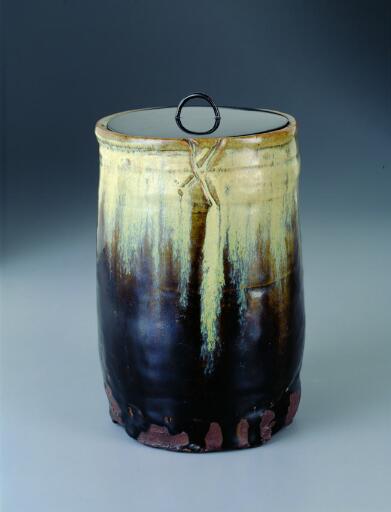
Water Jar (Mizusashi), c. 1700
Japanese
The subdued quality of Karatsu wares has been much appreciated by devotees of the tea ceremony. A mizusashi is a jar with a lid used to hold fresh water for pouring into the kama (kettle) or for rinsing the tea bowls and tea whisk. The Kimbell’s example is in the ware known as chosen-karatsu (in Korean, Karatsu), which is characterized by the bold combination of two different glazes—a white, straw-ash glaze and an iron oxide glaze that fires to a glossy dark brown—which streak and blur when they meet. Many pieces of chosen-karatsu, especially tall jars, were formed using the “patting method” (tataki)—coiling and paddling the clay vessel into shape—rather than on a wheel. The intentionally irregular contour of this jar and the incised X-shaped mark near the rim reflect the Japanese taste for pottery of a natural and often rustic authenticity, in which the direct touch of the potter’s hand is not hidden but brought to the fore and prized.
La sutileza de la cerámica Karatsu ha sido muy apreciada por los devotos de la ceremonia del té. El mizusashi es un jarro con tapa cuyo objeto es almacenar agua fresca para verter en la kama (tetera) o limpiar los cuencos y el agitador del té. El ejemplar del Kimbell pertenece al tipo conocido como chosen-karatsu (Karatsu, en coreano), que se caracteriza por presentar una llamativa combinación entre dos vidriados distintos: un vidriado blanco con cenizas de paja y uno con óxido de hierro que, al cocerse, adopta un tono marrón oscuro brillante; ambos vidriados se vetean y entremezclan cuando entran en contacto. Muchas piezas de chosen-karatsutataki) —enrollando la arcilla y dándole palmadas hasta lograr la forma— en lugar de con un torno. El contorno intencionalmente irregular de este jarro y la marca grabada en forma de X cerca del borde reflejan el gusto japonés por una cerámica de una autenticidad natural, y a menudo rústica, en la que no se ocultan las marcas de las manos del artesano, sino que se ponen de relieve y se valoran.
Harry Packard, by about 1966;
(N.V. Hammer, Inc., New York) by 1969;
acquired by Kimbell Art Foundation, Fort Worth, gift of N.V. Hammer, New York, 1971.