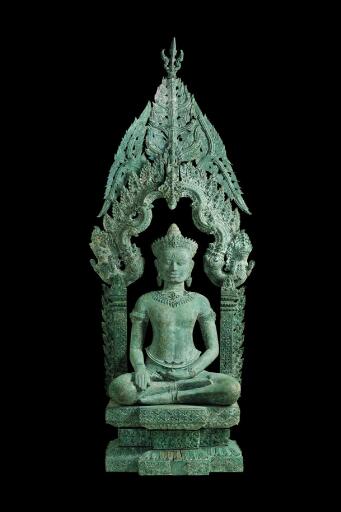
Buddha Enthroned, c. 1180–1220
Thai (Khmer)
The identification of Buddhist monarchs with overt symbols of worldly wealth and power was characteristic of the time of the Angkor king Jayavarman VII (1181–c. 1218). Although Buddhism rejects worldly possessions, the association of Khmer kings with gods was frequently expressed in sculpture decorated with royal regalia. By presenting the Buddha as possessing material wealth and power in richer images like the Kimbell sculpture, Jayavarman VII may have sought to identify himself with divine authority.
Instead of being represented as a monk meditating on a lotus pad, the Buddha is here depicted on an elaborate throne. The steep, intricately carved superstructure surmounted by a flame pattern invokes the form of the mountain-shaped pediments of Khmer temples with entwined foliate motifs and nagas, the serpent symbols of the power of the underworld: water and fertility. The Buddha is adorned with a diadem, heavy ear pendants, and richly jeweled necklaces, bracelets, and anklets. His right hand reaches down with extended fingers to make the earth-touching gesture, or mudra, known as Maravijaya, meaning “victory over Mara.” In this mode, the most frequently encountered gesture in Thai sculpture, the Buddha is calling on the earth to witness his victory over the seductive forces of the evil power of Mara, who tried to distract the Buddha from the meditation that would lead to his enlightenment.
Adult: Buddha Enthroned
La identificación de los monarcas budistas con símbolos manifiestos de riquezas terrenales y poder fue característica de la época del rey Jayavarman VII (1181–c. 1218) del Imperio Angkor. Pese a que el budismo rechaza las posesiones mundanas, la asociación de los reyes jemeres con los dioses se expresó con frecuencia por medio de esculturas decoradas con vestiduras reales. Podría entenderse que, al presentar al Buda como un individuo que poseía riquezas materiales y poder en imágenes opulentas como la escultura del Kimbell, Jayavarman VII buscaba identificarse con la autoridad divina.
En lugar de estar representado como un monje que medita sobre cojín de loto, aquí vemos al Buda sentado en un lujoso trono. La superestructura empinada, de complejo tallado, rematada por un patrón de llamaradas, evoca la forma de los frontones en forma de montaña de los templos jemeres, con motivos de follaje entrelazados con nagas, los símbolos serpentinos del poder del inframundo: el agua y la fertilidad. El Buda lleva por adorno una diadema, grandes pendientes en las orejas y collares, brazaletes y tobilleras repletos de joyas. Lleva la mano derecha hacia el suelo con los dedos extendidos, en un gesto, o mudra, conocido como Maravijaya, con el que toca la tierra, lo cual significa “victoria sobre Mara”. En este modo, el gesto más frecuente que encontramos en la escultura tailandesa, el Buda apela a la Tierra para que sea testigo de su victoria sobre las seductoras fuerzas del poder maligno de Mara, quien intentó distraer al Buda de la meditación que lo llevaría a la iluminación.
The recent conservation of Buddha Enthroned provided an opportunity to study its construction and examine its exquisitely preserved surface. The sculpture, which was created using a lost-wax casting process, is made up of eighteen separate pieces. The figure itself is composed of six parts: the head, chest with shoulders, each arm with its upper bracelet, the flower in the left hand and the legs with the waist cloth. The x-radiograph shows an iron armature in each arm that runs from the upper bracelet to the bracelet at the wrist. No armature, however, is present in the neck or torso. The neck area and upper arms are filled with solder at the joints, though it is unclear whether this is original or from later repairs. The x-radiograph also reveals an ancient repair of a casting flaw at the back of the waist. One of the questions that has concerned scholars is whether or not the base and the figure belong together. Since both exhibit the same type of burial dirt as well as the same type of corrosion, it seems likely that they were buried together. A sandy material was found on the back of the piece, which may suggest burial in a sandy environment or that the piece was buried in contact with a stucco. Precious sculptures were sometimes covered with stucco and buried in temples for safekeeping. This may explain why Buddha Enthroned was never melted down. Another question about the sculpture was whether or not the piece had surface decoration, which is found on some other examples. A single glass jewel remains in the crown, however, no further evidence of gilding or paint was found when the Buddha was examined with a microscope and ultraviolet light.
(Ellsworth & Goldie, Ltd., New York);
purchased by Kimbell Art Foundation, Fort Worth, 1966.