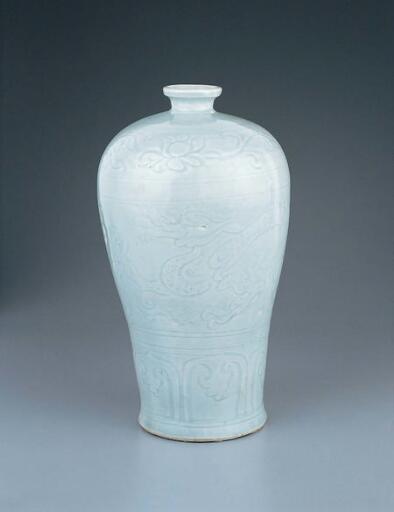
Meiping Vase, first half of the 14th century
Chinese
Qingbai wares of the Yuan dynasty continue an earlier tradition of porcelain wares covered with a transparent glaze, which began as early as the tenth century. The name qingbai (bluish white) refers to the faint bluish tint of the glaze in areas where it thickens. During the Yuan dynasty, qingbai wares were made primarily near Jingdezhen in Jiangxi province, which was later the site of the imperial Ming kilns. These simple but accomplished ceramics were important as the source of several later developments in porcelains during the Yuan, Ming (1368–1644), and Qing (1644–1911) dynasties.
The term meiping (plum blossom vase) describes a tall vase with a wide shoulder and small mouth. The decoration on this vase is arranged in three registers: carved floral scrolls on the shoulder, a carved dragon twisting through combed pattern clouds in the center register, and an upright band of incised, stylized petal motifs on the bottom register.
La cerámica qingbai de la dinastía Yuan es la continuación de una tradición anterior de porcelanas cubiertas con un vidriado transparente, que se inició ya en el siglo X. La denominación qingbai (blanco azulado) se refiere al leve tono azulado que adquiere el vidriado en las zonas en las que queda más espeso. Durante la dinastía Yuan, la cerámica qingbai se producía sobre todo en las proximidades de Jingdezhen, en la provincia de Jiangxi, que más tarde se convirtió en el emplazamiento de los hornos imperiales Ming. Estas cerámicas simples, pero bien logradas, fueron importantes por ser la fuente de varios desarrollos posteriores que afectaron a las porcelanas de las dinastías Yuan, Ming (1368–1644) y Qing (1644–1911).
El término meiping (vasija de flor de ciruelo) describe una vasija alta de hombro ancho y boca pequeña. La decoración de esta vasija se dispone en tres registros: en el hombro, roleos florales grabados; en el registro central, un dragón grabado que se retuerce a través de un patrón de nubes realizadas con la técnica del peinado; y, en el registro inferior, una franja grabada con motivos de pétalos verticales estilizados.
(N.V. Hammer, Inc., New York);
purchased by Kimbell Art Foundation, Fort Worth, 1968.