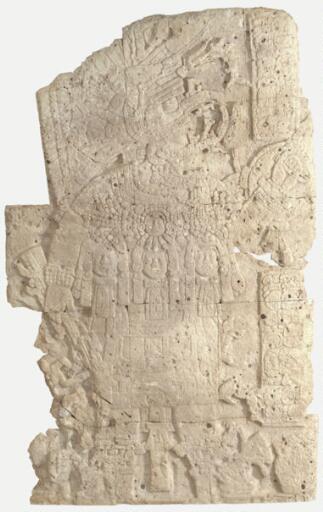
Stela with a Ruler, A.D. 692
Maya
The Maya were prolific makers of carved stone-slab monuments, or stelae, which were normally set up within architectural complexes and most often portray specific, named individuals who were members of the hereditary dynasties that ruled Maya city-states. This imposing figure is identified by the accompanying inscriptions as K’inich B’alam (Sun-Faced Jaguar), ruler of El Perú. The Kimbell stela was once part of a sculptural ensemble of three stelae displayed in a plaza at El Perú. The central monument, now in the Cleveland Museum of Art, represents on the same scale an equally intimidating woman, who may represent K’inich B’alam’s wife. The third stela still in situ portrays an unidentified male figure. The principal event commemorated by the Kimbell and Cleveland stelae is the ending in A.D. 692 of a k’atun, or twenty-year period, a date of special importance in the structure of Maya rulership.
The primary elements of K’inich B’alam’s costume were intended to situate the Maya ruler not just locally and in his historic role but, more importantly, in his relation to the gods and the cosmos. The main headdress element, repeated in the ruler’s anklets, is the head of the Water-lily Snake, a deity symbolizing standing bodies of water and the earth’s abundance, and patron god of the number thirteen. The several representations of fish leaping toward water-lily blossoms—at the top of the headdress and, less recognizably, at the back of the headdress and at either knee––reinforce this symbolism. Through these devices the ruler is shown as guarantor of agricultural success. The mosaic mask represents a jeweled serpent, and the round shield he grasps in his left hand emphasizes the war role of Maya rulers. Partly hidden by his left thigh is a deified perforator, used by the ruler at important period endings, like this one, to shed blood from his penis as an offering to the gods.
Los mayas tuvieron una producción prolífica de monumentos de piedra tallados, o estelas, que se colocaban, por lo general, dentro de complejos arquitectónicos y, en la mayoría de los casos, representaban a personas específicas, identificadas con nombre, que eran miembros de las dinastías hereditarias que gobernaban las ciudades-estado mayas. Esta impactante figura se encuentra identificada por las inscripciones que la acompañan como K’inich B’alam (Jaguar cara de sol), gobernante de El Perú. La estela del Kimbell fue antaño parte de un conjunto escultural de tres estelas dispuestas en una plaza de El Perú. En el monumento central, hoy en el Cleveland Museum of Art, se representa a una mujer igualmente intimidante a la misma escala, quien podría ser la esposa de K’inich B’alam. En la tercera estela, que aún se encuentra en el yacimiento, se representa a una figura masculina no identificada. El acontecimiento principal que se conmemora en las estelas del Kimbell y el Cleveland es la finalización, en el 692 d. C., de un k’atun, o un periodo de veinte años, fecha de especial importancia en la estructura de gobierno maya.
Los elementos principales del atuendo de K’inich B’alam tenían por objeto no solo situar al gobernante maya localmente en su papel histórico, sino también, y quizás lo que es más importante, en su relación con los dioses y el cosmos. El elemento principal del tocado, que se repite en las tobilleras del gobernante, es la cabeza de la serpiente nenúfar. Es una deidad que simboliza las masas de agua estancadas y la abundancia de la Tierra. También es patrona del número trece. Las varias representaciones de peces saltando hacia las flores de los nenúfares —en la parte superior del tocado y, aunque menos reconocible, en la parte posterior del tocado y en las rodillas— refuerzan el simbolismo. Por medio de estos elementos se presenta al gobernante como garante de la prosperidad agrícola. La máscara de mosaico representa a una serpiente adornada con joyas, y el escudo redondo que sostiene el gobernante en la mano izquierda pone de relieve el papel bélico que desempeñaban los gobernantes mayas. En parte oculto tras su muslo izquierdo, vemos a un perforador deificado, a quien el gobernante encargaba, cuando terminaba un periodo importante como este, la tarea de derramar sangre de su pene en ofrenda a los dioses.
New York art market by 1969.
(John A. Stokes, New York);
purchased by Kimbell Art Foundation, Fort Worth, 1970.