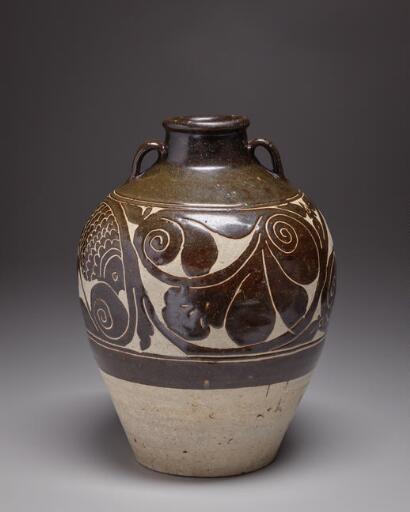
Vase with Fish and Foliate Scroll Design, 14th century
Chinese
Cizhou is the designation for a large and varied group of cream-colored stonewares decorated with painted designs under a transparent glaze, or by incising, stamping, or carving into a colored slip. First developed in the Song period (960–1279) and named for the kilns in the Cizhou area of Hebei province, they were made throughout north China from the tenth to the fifteenth century. While there is a considerable variety of slips, glazes, and vessel shapes, all Cizhou wares share a distinctive decoration in which large-scale motifs play on the contrast of light and dark tones. Cizhou wares are somewhat unrefined and were generally made for everyday utilitarian use in the homes of the middle class.
This vase’s bold design of large foliate scrolls and fish was achieved by incising and removing areas of a dark brown slip that had been applied to the whole vase. Initially, the slip was cut away from the lower third of the jar to reveal the cream-colored body of the stoneware. The deeply incised outlines of the floral design and some details, most notably the eyes and the scale pattern of the fish, were then cut through the remaining slip. Finally, the background area of the floral design was scraped away. The result is a striking design that exploits the juxtaposed contrast of light and dark tones, and the differing textures of the glossy slip and matte stoneware.
Cizhou es el nombre que se da a un grupo numeroso y variado de cerámicas de gres de color crema, decoradas con diseños pintados bajo un vidriado transparente o con grabados, estampados o tallados sobre un fondo de color. Producidas por primera vez en el periodo Song (960–1279) y denominadas Cizhou por los hornos de la zona homónima de la provincia de Hebei, estas cerámicas se fabricaron en todo el norte de China desde el siglo X and XV. Pese a que hay una cantidad considerable de fondos, vidriados y formatos de vasijas, todas las piezas Cizhou comparten una decoración característica en la que contrastan motivos de gran tamaño con tonos claros u oscuros. Las cerámicas de Cizhou son, de alguna manera, poco refinadas y se producían, por lo general, para ser destinadas a un uso utilitario en hogares de clase media.
El llamativo diseño de esta vasija, conformado por grandes volutas de follaje y peces, se obtuvo grabando y quitando partes del fondo color marrón oscuro que se había aplicado a toda la vasija. En primer lugar, se retiró el fondo del tercio inferior de la vasija para dejar a la vista el cuerpo color crema de la cerámica de gres. Los profundos contornos del diseño floral y algunos detalles, en especial los ojos y el patrón de escamas de los peces, se grabaron luego sobre el fondo que restaba. Por último, se eliminó el fondo del diseño floral. El resultado es un diseño sorprendente que aprovecha el contraste generado por la yuxtaposición de tonos claros y oscuros, y las distintas texturas del fondo brillante y la cerámica mate.
(N.V. Hammer, Inc., New York), by 1969;
purchased by Kimbell Art Foundation, Fort Worth, 1970.