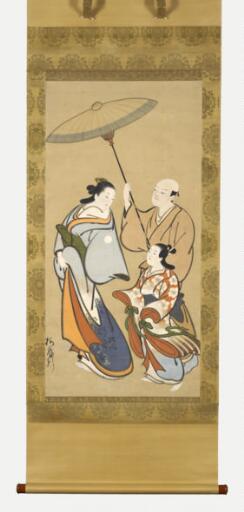
Courtesan in a Procession, c. 1720–30
Baioken Eishun, Japanese
Ukiyo-e paintings are perceptive reflections of life in the entertainment quarters of Japanese cities during the Edo period (1615-1868). The outings and amusements of citizens, as well as lavishly dressed courtesans and their patrons, are depicted in paintings that are sensuous, emotional, and decorative. This scroll depicts a scene enacted daily as a stately courtesan proceeds proudly through the streets. The high-ranking courtesan turns to look at her young attendant who pads along happily wearing the long-sleeved furisode kimono reserved for unmarried girls.
The male retainer holding an umbrella over the courtesan is an emblem of her status. He is carefully distinguished as separate and subordinate by his clothes and position, as well as by his disinterested air. Little is known about Eishun other than the fact that he was a follower of the Kaigetsudo school of ukiyo-e and, like others of that school, painted pictures of the courtesans who lived in the Yoshiwara entertainment district of Edo (modern-day Tokyo). The courtesan’s pose as she turns to look back, the full left sleeve hanging empty at her side, and the strong black contours of the figures are in accord with the formula established by the Kaigetsudo school.
Baron Seikai Kuki, Hyogo prefecture, Tokyo;
by descent to Ryuichi Kuki, Tokyo, by 1932;
(N.V. Hammer, Inc., New York), by 1969;
purchased by Kimbell Art Foundation, Fort Worth, 1970.