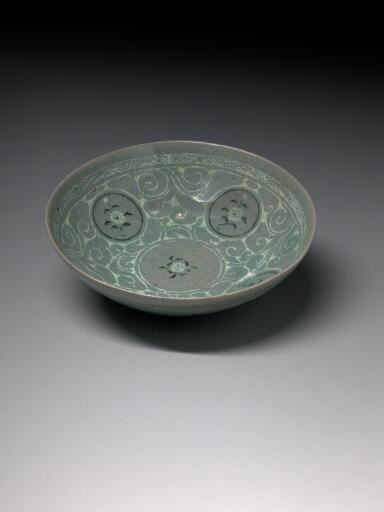
Bowl, 12th or 13th century
Korean
One of the most significant contributions of the Korean potter to ceramic art was the technique of slip-inlay (sanggam). Developed around the mid-twelfth century, the technique quickly became a national specialty. The inlay was produced by first incising or stamping designs into the clay, and then filling the depressions with white or black slip before glazing and firing.
This shallow bowl demonstrates the variety of decorative effects that can be achieved with this technique. The chrysanthemum blossoms on the exterior and in the center of the interior medallions were stamped and then filled with white slip. The greenish black leaves and surrounding design were freely carved with a V-shaped knife. In a technique known as reverse inlay (yoksanggam), the background of the curling, gray green foliage, rather than the leaves themselves, was carved out and filled with white slip.
Una de las contribuciones más significativas de los alfareros coreanos al arte de la cerámica fue la técnica de las incrustaciones de barbotina (sanggam). Desarrollada alrededor de mediados del siglo XII, esta técnica pronto se convirtió en una especialidad nacional. Las incrustaciones se lograban, primero, grabando o estampando los diseños sobre la cerámica, para luego rellenar los surcos con barbotina blanca o negra antes de aplicar el vidriado u hornear las piezas.
Este cuenco poco profundo es un excelente ejemplo de la variedad de efectos decorativos que pueden lograrse mediante esta técnica. Las flores de crisantemo del exterior, así como en el centro de los medallones que vemos en el interior, fueron estampadas y rellenadas más tarde con barbotina blanca. Las hojas negras verdosas y el diseño que las rodea se grabaron a mano alzada con una espátula en forma de V. El fondo del follaje gris verdoso que forma volutas —y no las hojas en sí— se grabó y rellenó con barbotina blanca, aplicando una técnica conocida como incrustación reversa (yoksanggam).
(N.V. Hammer, Inc., New York) by 1969;
purchased by Kimbell Art Foundation, Fort Worth, 1970.