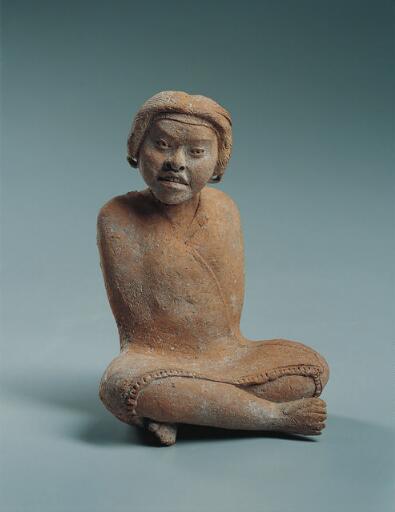
Seated Woman, c. 1500–1200 B.C.
Xochipala
The Xochipala figures are named after the remote West Mexican village near which all known examples have been found. The style is one of extraordinary physical presence and naturalism for its period. Characteristic of this regional style are anatomical details rendered with consummate skill: fully modeled eyeballs with pierced pupils, parted lips revealing two rows of teeth, finely worked feet with fanned toes, and delicately incised hair fashioned into a stylized arrangement. This figure embodies all of these traits, and though small in size, is modeled with remarkable sophistication, especially in the intent facial expression, articulated coiffure, and delicately fringed shawl, all accentuated by the extreme simplicity of the dress. Its success in capturing the spirit and physical presence of an actual woman inevitably raises the question of whether it was intended, in some sense, to be a portrait.
Las figuras Xochipala toman su nombre de un pueblo remoto del oeste de México, cerca del cual se han encontrado todos los ejemplares que se conocen hasta el momento. El estilo posee una presencia física y un naturalismo extraordinarios para la época. Son característicos de este estilo regional los detalles anatómicos ejecutados con una habilidad consumada: globos oculares completamente modelados con pupilas perforadas, labios entreabiertos que dejan ver dos hileras de dientes, pies delicadamente trabajados con dedos en forma de abanico y cabello tallado con delicadeza en una disposición estilizada. Esta figura encarna todas estas características y, pese a su pequeño tamaño, se encuentra modelada con considerable sofisticación, en especial en la expresión atenta, el peinado articulado y el manto de delicados flecos, todo lo cual se pone de relieve gracias a la simplicidad del atuendo. La perfección con la que captura el espíritu y la presencia física de una mujer real nos hace preguntarnos inevitablemente si se trató, de alguna manera, de un retrato.
(John Stokes, New York);
purchased by Kimbell Art Foundation, Fort Worth, 1971.