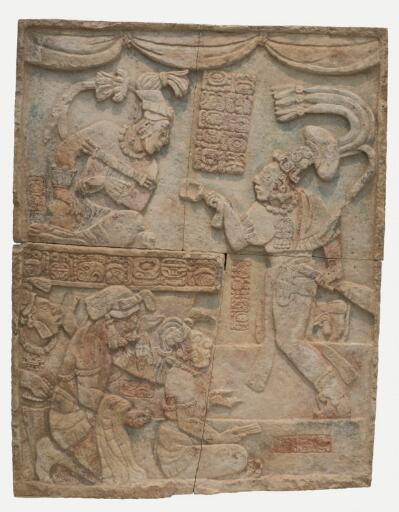
Presentation of Captives to a Maya Ruler, c. A.D. 785
Maya
This carved relief probably served as a wall panel inside a Maya building or as a lintel over an entrance. It depicts the presentation of captives in a palace throne room, indicated by swag curtains at the top of the panel. The five figures are the Yaxchilan king, seated at top left, his sahal (a military chief) on the right, and three bound captives in the lower left. The glyphic text, which gives a date of 23 August 783, records the capture of a lord and a sacrificial bloodletting three days later under the auspices of the king. The three prisoners may be scribes; the one in front holds a “stick-bundle” associated with Maya scribes, and all three wear headdresses with hun (book) knots. All figures but the leftmost captive are identified by name. The inscription on the throne front, of special interest, is carved with the king’s name and titles; the glyphs are inscribed in reverse order, from right to left.
The name of the artist responsible for sculpting the relief appears on the vertical panel of four glyphs under the sahal’s outstretched arm. Signed works of Maya art are rare, and the signature on this relief suggests that it was considered of great value in its time.
Adult: Presentation of Captives to a Maya Ruler
Este panel tallado en relieve probablemente sirviera para recubrir una pared en un edificio maya o como dintel sobre una entrada. En él vemos la presentación de un grupo de cautivos en el salón del trono de un palacio, lo que se indica mediante las cortinas enrolladlas en la parte superior del panel. Las cinco figuras son el rey Yaxchilan, sentado en la parte superior izquierda, su sahal (jefe militar) a la derecha, y tres cautivos maniatados en la parte inferior izquierda. Los glifos, que señalan la fecha 23 de agosto de 783, registran la captura de un noble y un sacrificio de sangría tres días más tarde bajo los auspicios del rey. Los tres prisioneros podrían ser escribas: el que está al frente sostiene el “atado de varillas” asociado con los escribas mayas, y los tres llevan tocados con nudos hun (libro). Todas las figuras, a excepción del cautivo que se encuentra en el extremo izquierdo, están identificadas con nombre. La inscripción frente al trono, de especial interés, lleva grabados el nombre y los títulos del rey; los glifos se encuentran ordenados a la inversa, de derecha a izquierda.
El nombre del artista responsable de esculpir el relieve aparece en el panel vertical de cuatro glifos que se encuentra debajo del brazo extendido del sahal. Son excepcionales los casos de arte maya que llevan firma, y la que vemos en el relieve sugiere que la obra se consideró muy valiosa en su época.
New York art market by March 1970.
(John A. Stokes, New York);
purchased by Kimbell Art Foundation, Fort Worth, 1971.