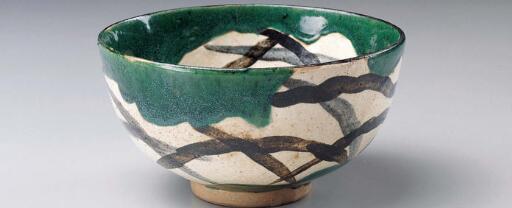
Bowl with Pampas Grass Design, early 18th century
Ogata Kenzan, Japanese
Ogata Kenzan was one of the three great masters of painted ceramics in the Edo period (1615–1868). He developed an imaginative ceramic style characterized by a harmony between deftly painted designs and simple, sturdy ceramic forms. His workshop, based in Kyoto and later in Edo (Tokyo), also developed innovative uses of pigments and glazes. His distinctive style of freely brushed grasses, blossoms, and birds was employed especially for decorating tea ceramics.
Kenzan’s early training as a painter is evident in the Bowl with Bamboo Leaf Design, where the thinness and tonal variations of the brushwork are evocative of ink painting. Both the intentionally asymmetrical shape, and the sharp-edged leaves and contrasting colors and textures of the glazes, reflect the aesthetics of the tea ceremony, which were designed to appeal to different senses during the extended ritual of drinking. The bowl was originally part of a set of five or perhaps ten vessels that may have been made as mukozuke (side dishes) or kumidashi chawan (cups used for serving tea in a waiting room). Although the graceful design of the Bowl with Pampas Grass Design is just as carefully conceived, the end result appears more casual, with the bright green glaze dripping onto either side of the bowl. It was originally one of a larger set of futa-chawan (covered tea bowls) used for serving steamed food.
Ogata Kenzan fue uno de los tres grandes maestros de la cerámica pintada en el periodo Edo (1615–1868). Creó un novedoso estilo de cerámica caracterizado por una armonía entre diseños pintados con gran destreza y formas sencillas y macizas. Su taller, con sede primero en Kioto y luego en Edo (Tokio), también fue responsable del desarrollo de usos innovadores para los pigmentos y los vidriados. Su estilo característico de pastos, flores y aves pintados con pinceladas sueltas se empleó particularmente en la decoración de cerámica para el té.
La formación temprana de Kenzan como pintor se evidencia en la ejecución de este cuenco. A pesar de que el elegante diseño ha sido planeado con cuidado, el resultado final da la impresión de ser espontáneo por la forma en que el vidriado verde intenso chorrea a cada lado del cuenco. Los colores y las texturas contrastantes de los esmaltes reflejan la estética de la ceremonia del té, diseñada para apelar los distintos sentidos durante la extensa ceremonia en la que se disfrutaba del té. Originalmente, este cuenco formaba parte de un juego mayor de futa-chawan (cuencos para té cubiertos) utilizados para servir comidas al vapor.
(Jean-Pierre Dubosc [1904-1988], Paris), possibly sometime between 1929 and 1947;
purchased by Kimbell Art Foundation, Fort Worth, 1971.