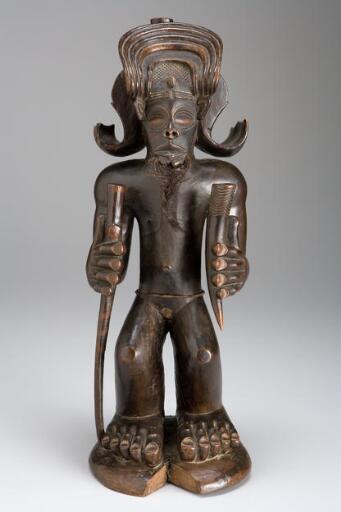
Chibinda Ilunga, mid-19th century
Chokwe
This imposing figure represents the hero Chibinda Ilunga, royal ancestor of the Chokwe people. According to legend, Ilunga, the son of a great Luba chief, wooed Lweji, a Lunda chieftainess. He introduced into that tribe the concept of divine kingship and also taught the Lunda the art of hunting. From their union, if rather indirectly, came the Mwata Yamvo rulers of the Lunda, to whom the Chokwe not only paid tribute, but also regularly furnished sculptors who produced many kinds of court art almost up to the present day. By association, Chibinda Ilunga became a culture hero and model for Chokwe chiefs as well.
The figure of Chibinda Ilunga came to represent the archetypal chief who maintains the well-being of his people, and he also served as a role model for men in Chokwe society. This figure wears elaborate headgear with rolled side elements as a sign of his royal rank. He holds a staff in his right hand and a carved antelope horn in his left. Since the hunter chief was the most sacred subject portrayed by the Chokwe, such figures were attempted only by the most skilled artists. This sculpture conveys the physical strength and stealth of the hunter’s body as well as the sensitivity and intelligence of a great leader’s face.
Adult: Chibinda Ilunga
Children's: Chibinda Ilunga
Esta imponente figura representa al héroe Chibinda Ilunga, ancestro real del pueblo chokwe. Cuenta la leyenda que Ilunga, hijo de un gran jefe luba, cortejaba a Lweji, una cacique lunda. Él introdujo en aquella tribu el concepto de realeza divina y también enseñó a los lunda el arte de la caza. De su unión, aunque algo indirectamente, nacieron los gobernantes Mwata Yamvo de los lunda, a quienes los chokwe no solo rendían tributo, sino que además proporcionaban escultores que realizaron distintos tipos de arte cortesano casi hasta el día de hoy. Por asociación, Chibinda Ilunga se convirtió en héroe de culto, así como en modelo de los jefes chokwe.
La figura de Chibinda Ilunga pasó a representar el arquetipo de jefe que vela por el bienestar de su pueblo; además, sirvió de modelo a seguir para los hombres de la sociedad chokwe. Esta figura lleva un tocado muy elaborado con elementos laterales que se curvan hacia arriba y reflejan su estatus real. En la mano derecha lleva un bastón y, en la izquierda, un cuerno de antílope tallado. Como el jefe cazador era el sujeto más sagrado que los chokwe representaban, solo los artistas más habilidosos osaban crear estas figuras. Esta escultura transmite tanto la fuerza física y el sigilo del cuerpo del cazador como la sensibilidad y la inteligencia del rostro de un gran líder.
Fred Abecassis, probably Angola, before 1900;
private collection from 1940;
(sale, Christie, Manson & Woods, Ltd., London, 13 June 1978, no. 254);
(Walter Randel, New York);
purchased by Kimbell Art Foundation, Fort Worth, 1978.