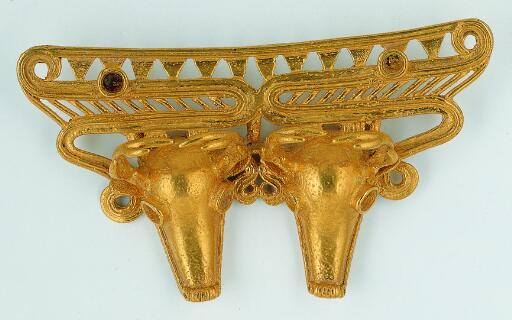
Pendant: Two Deer Heads, c. 700–1200
Conte Style
The art of casting elaborate designs in gold had emerged in Panama by the middle of the first millennium a.d.; regional schools excelled in the techniques of cast and beaten gold. Gold became the primary prestige material in this region, and high-status individuals wore numerous ornaments in this material, which were later placed in quantity in their burials.
One of the most distinctive regional styles of Panama is that of the Conte group. In the Two Deer Heads pendant, what may initially appear as merely decorative elaboration above the deer heads is in fact an artful stylization—a pair of outward-facing profile heads of an important deity, a crested saurian. The long, many-toothed snout of the crocodile is topped by a notched “crest” that alludes to the skin texture of the crocodile and other lizards. The eyes of all four heads were once inset with bone, amber, or hardstone. The pendant may have had a talismanic function, invoking saurian or other animal spirits that were believed to have a special protective relationship to the wearer.
El arte de elaborar complejos diseños de oro fundido surgió en Panamá hacia mediados del primer milenio d. C.; las escuelas regionales se destacaron por las técnicas con las que trabajaban el oro fundido y batido. El oro se convirtió en el principal material de prestigio en esta región, y las personas de elevado estatus usaban numerosos adornos de este material, que se colocaban más tarde en grandes cantidades en sus tumbas.
Uno de los estilos regionales más característicos de Panamá es el del grupo conte. En el colgante de Dos cabezas de ciervo, lo que en un principio podría parecer una elaboración meramente decorativa sobre las cabezas de los ciervos es, de hecho, una estilización artística: un par de cabezas de perfil mirando hacia afuera de una importante deidad, un saurio con cresta. El hocico largo y lleno de dientes del cocodrilo está rematado con una “cresta” con muescas que alude a la textura de la piel del cocodrilo y otros reptiles. Los ojos de las cuatro cabezas tuvieron antaño incrustaciones de hueso, ámbar y piedras duras. El colgante podría haber funcionado como un talismán con el que invocar al espíritu del saurio u otros animales, quienes, según se creía, entablaban una relación especial de protección con quien llevara el colgante.
Private collection, Florida, by 1957;
Mr. Henry Weinstock, New York, 1957 to 1979;
Malcolm G. Delacorte, New York, 1979;
Dr. Nadine B. Castro, New York, 1979;
purchased by Kimbell Art Foundation, Fort Worth, 1979.