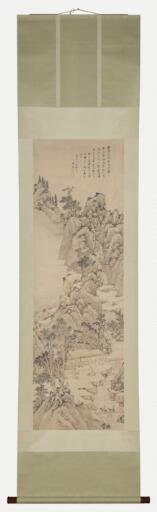
Landscape in the Style of Dong Yuan, 1577
Wen Jia, Chinese
Wen Jia, a recognized poet, critic, and connoisseur of painting, was the second son of Wen Zhengming (1470–1559), one of the literati artists of the Wu school in Suzhou during the Ming dynasty (1368–1644). Meticulous brushwork, cool coloring, and a conservative temperament characterize his paintings.
This scroll is one of Wen Jia’s largest extant paintings and depicts a tall, narrow landscape crowded with wooded mountains, winding paths, torrents, and leafy trees executed in ink and pale colors. It illustrates the interest of Wu school artists in the work of earlier masters: Wen Jia’s inscription states that the composition was inspired by a specific painting by the tenth-century master Dong Yuan. The bold, rocky mass that curves up the center of the painting is reminiscent of the mountain masses that dominate the center of many Northern Song (960–1127) landscapes. The use of dots for foliage, and of long hemp-fiber strokes to give texture to the rocks, recalls the technique of the founder of the Wu school, Shen Zhou (1427–1509), who in turn followed Northern Song conventions. On the other hand, the spatial ambiguity in this painting—horizons that do not match and disjointed land masses that have no organic relationship—is a feature exploited by a later Ming master, Dong Qichang (1555–1636).
Wen Jia, reconocido poeta, crítico y entendido de la pintura, fue el segundo hijo de Wen Zhengming (1470–1559), uno de los artistas intelectuales de la escuela Wu de Suzhou durante la dinastía Ming (1368–1644). Sus pinturas se caracterizan por presentar pinceladas minuciosas, una paleta fría y un temperamento conservador.
Este rollo es una de las pinturas más grandes que se conservan del artista; representa un paisaje alargado y estrecho, repleto de montañas boscosas, caminos serpenteantes, torrentes de agua y árboles frondosos ejecutados en tinta y colores pálidos. La pintura ilustra el interés de los artistas de la escuela Wu por la obra de maestros anteriores: la inscripción de Wen Jia explica que la composición está inspirada en una pintura específica del maestro del siglo X Dong Yuan. La llamativa masa rocosa que aparece curvada en el centro de la composición recuerda a las masas montañosas que dominan el centro de muchos paisajes realizados durante la dinastía Song del Norte (960–1127). El uso de puntos para representar el follaje y las pinceladas largas realizadas con fibras de cáñamo para dar textura a las rocas recuerdan a la técnica del fundador de la escuela Wu, Shen Zhou (1427–1509), quien a su vez seguía las convenciones de la dinastía Song del Norte. Por otro lado, la ambigüedad espacial de esta pintura —con horizontes que no se corresponden y masas de tierra inconexas sin relación orgánica alguna— es una característica que explotó más adelante el maestro Ming Dong Qichang (1555–1636).
Etablissement des Beaux-Arts du Monde, Vaduz, Liechtenstein, since 1979;
(N. V. Hammer, Inc., New York) as agent for the Etablissement des Beaux-Arts du Monde, Vaduz, Liechtenstein;
purchased by Kimbell Art Foundation, Fort Worth, 1980.