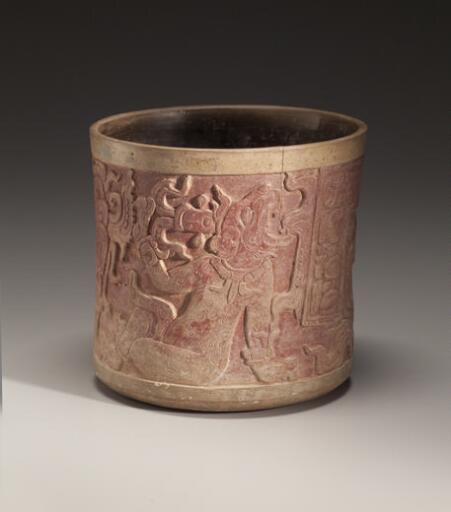
Vessel with Two Gods before a Mountain, c. A.D. 700–800
Maya
The elaborate mythological scene on this vessel, carved in low relief in the leather-hard clay before firing, achieves at a smaller scale much the same effect as the Maya stone relief carvings. On either side of an inverted L-shaped panel of five glyphs, the Water-lily Jaguar and Chak face one another. In this pairing, they are depicted as actors in a sacrificial death dance. Chak, the god of rain and lightning, is identified by shell earflares and a shell diadem, by long hair gathered together and tied, and by his thunderbolt axe. He is seated before the so-called Kawak Monster, the head of a creature covered in reptilian scales, and with half-closed eyes and a huge tongue that drops to the ground from its gaping mouth. This is actually the iconic form of witz, “mountain,” and it seems as if the rain god, who dwells in mountain caves, has just emerged from his home. The Water-lily Jaguar is identified by a water-lily blossom or leaf on his head, death-eye cuffs and collar, and a pattern of spots on his body. While he is a jaguar, his motions and postures are, in most representations, those of a human.
La elaborada escena mitológica de esta vasija, tallada en bajorrelieve en la arcilla con dureza de cuero antes de ser horneada, logra a una escala menor casi el mismo efecto que los relieves mayas en piedra. Al otro lado de un panel de cinco glifos con forma de L invertida, vemos al Jaguar Nenúfar y a Chak enfrentados. En esta pintura se los representa como actores en una danza de muerte expiatoria. Chak, dios de la lluvia y los truenos, se encuentra identificado por los aretes y la diadema de caracolas, el cabello largo y atado, y su hacha en forma de rayo. Está sentado frente al llamado Monstruo Kawak, cabeza bestial recubierta de escamas de reptil, con ojos entreabiertos y una gran lengua que cuelga hasta el suelo desde su boca abierta. Se trata, de hecho, de la forma icónica de witz, “montaña”, y pareciera que el dios de la lluvia, que habita en las cuevas de las montañas, acaba de salir de su morada. El Jaguar Nenúfar se identifica gracias a la flor u hoja de nenúfar que lleva en la cabeza, los brazaletes y el collar de ojos de la muerte, y el patrón moteado de su cuerpo. Si bien es un jaguar, su movimiento y posturas son, en la mayoría de las representaciones, propios de un humano.
(Alphonse Jax, New York);
purchased by Kimbell Art Foundation, Fort Worth, 1980.