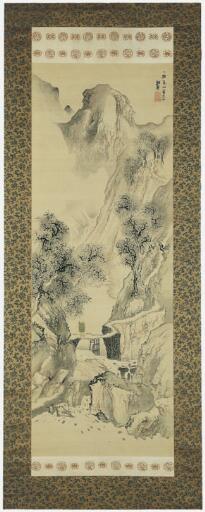
Landscape with a Solitary Traveler, c. 1780
Yosa Buson, Japanese
The nanga (southern painting) school, also called bunjinga (literati painting), was one of the two most dynamic schools of Japanese painting during the eighteenth and first half of the nineteenth century. In contrast to the sensuous school of native decorative art, called ukiyo-e (pictures of the floating world), the nanga school was the last manifestation of the centuries-old Japanese preoccupation with China. It was based on the monochrome-ink landscape styles of Chinese literati painters, adopted and modified according to Japanese taste, and was patronized principally by the cultivated upper strata of Japanese society living in Kyoto. Yosa Buson was one of the two greatest painters of the nanga school.
This scroll depicts a landscape punctuated by a narrow road that emerges from behind a large boulder on the left side of the painting and winds upward through the mountains on the right. A solitary traveler wrapped in a green cloak crosses a footbridge constructed over a swollen, rushing stream. Inscribed on the scroll is the last line of a poem by the Tang-period poet Han Yu (A.D. 768–824): A single path in cold mountains through the myriad streams. Using this quote as his theme, Buson evokes the sense of cold through the pale green and gray coloring, the leafless trees, and the traveler’s cloak.
La escuela nanga (pintura del sur), también denominada bunjinga (pintura de los intelectuales), fue una de las escuelas de pintura japonesa más dinámicas durante el siglo XVIII y la primera mitad del XIX. A diferencia de la sensual escuela de arte decorativo autóctono, denominado ukiyo-e (imágenes del mundo flotante), la escuela nanga fue la última manifestación de la antiquísima obsesión japonesa por la China. Estaba basada en el estilo de los paisajes a la tinta monocroma de los pintores eruditos chinos, aunque modificado para adaptarlo al gusto japonés. Esta escuela recibió el mecenazgo principalmente de los estratos más altos y cultos de la sociedad japonesa de Kioto. Yosa Buson fue uno de los dos pintores más importantes de la escuela nanga.
En este rollo se representa un paisaje marcado por un camino estrecho, que nace de una gran roca ubicada a la izquierda de la pintura, y asciende serpenteando entre las montañas de la derecha. Un viajero solitario, envuelto en un manto verde, cruza una pasarela construida sobre las aguas crecidas de un arroyo que avanza con fuerza. Inscrito en el rollo se lee el último verso de un poema escrito por Han Yu (768–824 d. C.), poeta del periodo Tang: Un único camino entre las frías montañas atraviesa mil arroyos. Con esta cita como tema, Buson evoca la sensación de frío por medio de los colores verde pálido y gris, así como los árboles sin hojas y el manto del viajero.
(Kochukyo Co., Ltd., Tokyo);
purchased by Kimbell Art Foundation, Fort Worth, 1981.