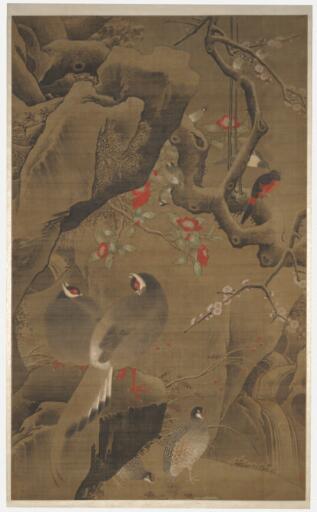
Birds and Flowers of Early Spring, c. 1500
Yin Hong, Chinese
Colorful flower-and-bird paintings were created by courtpainters during the Ming dynasty (1368–1644) to decorate the grand halls of imperial palaces, where they could also serve as metaphors for the emperor and his court. Yin Hong, a third- generation court painter, was recognized for his skill at depicting “feathers and fur.”
This handsome painting evokes the passage from winter to spring with a combination of camellias and blossoming plum. The rocks, water, trees, blossoms, and birds are treated here as stylized formal elements in a grand design. Dark washes of ink and vigorous strokes form interlocking planes of strong, flat forms. Rich green leaves and red-and-white blossoms animate the central diagonal with touches of brilliant color. The birds—little bulbuls and the red-breasted minivet (on the prunus branch), partridges (lower-right foreground), and brown-eared pheasants (on the rock cliff)—contribute to the patterned effect and tactile richness of the surface. Beyond its highly decorative qualities, the subject of the painting is also an allusion to imperial allegiance; the pheasants are symbolic of bravery and steadfastness, while the partridges represent the faithful followers of the emperor.
Adult: Birds and Flowers of Early Spring
Las coloridas pinturas de aves y flores fueron realizadas por los pintores de la corte durante el dominio de la dinastía Ming (1368–1644) para decorar los grandes corredores de los palacios imperiales, donde también servían de metáforas para el emperador y su corte. Yin Hong, perteneciente a la tercera generación de pintores cortesanos, era reconocido por su habilidad para representar “plumas y pelajes”.
Esta bella pintura evoca el paso del invierno a la primavera con una combinación de camelias y ciruelos en flor. Las rocas, el agua, los árboles y las aves se tratan aquí como elementos formales estilizados dentro de un grandioso diseño. Los planos entrelazados de formas planas y enérgicas se realizan en oscuras aguadas de tinta y enérgicas pinceladas. La diagonal central se ve animada por abundantes hojas verdes y flores rojas y blancas, así como por toques de colores vivos. Las aves —pequeños bulbuls y el minivet de pecho rojo (sobre la rama del ciruelo), perdices (primer plano en el extremo inferior derecho) y faisanes orejudos pardos (en el acantilado)— contribuyen a lograr el efecto estampado y la riqueza táctil de la superficie. Más allá de su gran cualidad decorativa, el tema de la pintura es también una alusión a la alianza imperial: los faisanes simbolizan la valentía y la perseverancia, mientras que las perdices representan a los fieles seguidores del emperador.
(Klaus F. Naumann, Tokyo);
purchased by Kimbell Art Foundation, Fort Worth, 1982.