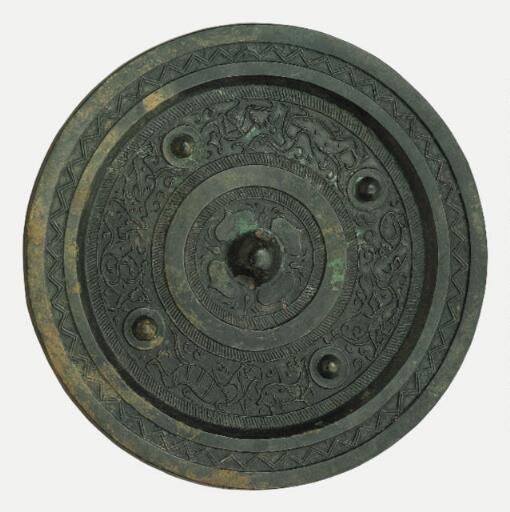
Mirror with Animals and Figure, c. A.D. 100
Chinese
In ancient China, from at least the Shang dynasty (c.1600–1100 B.C.), mirrors served both as functional articles of daily life and as sacred objects possessing powers of their own. By the fourth century B.C., the custom had developed of placing mirrors in tombs. The Chinese believed that mirrors had the ability not only to reflect the truth, and thus ward off evil demons who could not bear to look upon them-selves, but also to radiate light and illuminate the tomb for eternity.
The geometric motifs and naturalistic forms used to decorate this mirror have symbolic meaning. The four prominent, raised bosses that divide the field into four parts refer to the four cardinal directions and quadrants of the universe. Seven real and fantastic animals follow each other around the band. The group includes three of the traditional “spirit animals” of the four directions: the Green Dragon of the East; the White Tiger of the West; and the Red Bird of the South. The Black Tortoise of the North is here replaced by a pair of rodentlike quadrupeds. The two remaining animals cannot be identified. The eighth figure is a creeping human with fringes on his arms and legs, possibly one of the Taoist immortal “feathered men.” Tiny bosses scattered seemingly at random over the surface represent stars grouped as constellations.
En la antigua China, al menos a partir de la dinastía Shang (c. 1600–1100 a. C.), los espejos servían tanto de objetos funcionales para la vida cotidiana como de objetos sagrados con poderes propios. Hacia el siglo IV a. C. se había desarrollado la costumbre de colocar espejos en las tumbas. Los chinos creían que los espejos tenían la capacidad no solo de reflejar la verdad —y, por tanto, de alejar a los demonios, incapaces de mirar su propio reflejo—, sino también de irradiar luz e iluminar la tumba por toda la eternidad.
Los motivos geométricos y las formas naturalistas utilizadas en la decoración de este espejo poseen un significado simbólico. Los cuatro prominentes tachones en relieve que dividen el campo en cuatro partes hacen referencia a los cuatro puntos cardinales y a los cuadrantes del universo. Alrededor de la franja, siete animales reales y fantásticos se disponen uno detrás de otro. El grupo incluye tres de los “animales espíritu” tradicionales de las cuatro direcciones: el Dragón verde del Este, el Tigre blanco del Oeste, y el Ave roja del Sur. La Tortuga negra del Norte se encuentra aquí reemplazada por un par de cuadrúpedos similares a un roedor. Los dos animales restantes no han podido ser identificados. La octava figura es un ser humano gateando con flecos en los brazos y las piernas, posiblemente uno de los “hombres con plumas” de los inmortales taoístas. Los pequeños tachones que parecen dispuestos al azar sobre la superficie representan estrellas agrupadas en constelaciones.
(London Gallery, Ltd., Tokyo);
purchased by Kimbell Art Foundation, Fort Worth, 1984.