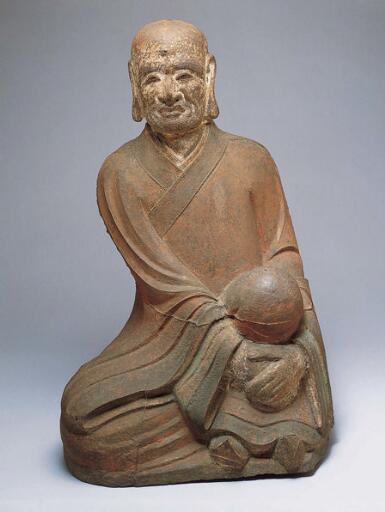
Seated Arhat, c. 1300–1450
Chinese
This engaging portrait of a monk represents an arhat (in Chinese, lohan), one of a group of “perfected beings” who, in the Buddhist faith, were the original disciples of Shakyamuni Buddha. Like bodhisattvas, arhats have attained perfection but have delayed entering nirvana and becoming buddhas so that they may aid others in seeking enlightenment. Arhats were regarded as having achieved extraordinary spiritual levels that endowed them with superhuman capabilities. Usually appearing in groups of four, sixteen, eighteen, or even as many as five hundred or a thousand, the arhats were depicted as monks and ascetics, sometimes with exaggerated features such as long eyebrows or domed heads, and some were associated with particular attributes. Although lists identifying each arhat exist, the descriptions are generally vague, and precise identifications of individual figures are difficult.
The realism and humanity in the Kimbell arhat’s face contrast with the simplified but rhythmical form of the body to produce a portrait of great character and presence. An inscription on the back of the statue names a large group of donors who commissioned and paid for the work, and gives the name of the temple, Yuhua, in Shanxi province, to which it was donated, and where it may have been installed as part of a larger group of arhat portraits.
Este cautivador retrato de un monje representa a un arhat (lohan, en chino), parte de un grupo de “seres perfeccionados” que, en la fe budista, eran los discípulos originales del Shakyamuni Buda. Al igual que los bodhisattvas, los arhats han alcanzado la perfección, pero han pospuesto su ingreso al nirvana y se han convertido en budas para poder ayudar a otros en la búsqueda de su iluminación. Se consideraba que los arhats habían alcanzado un nivel espiritual extraordinario que les otorgaba habilidades sobrehumanas. Los arhats, que aparecen, por lo general, en grupos de cuatro, dieciséis, dieciocho o incluso hasta de quinientos o mil, se representaban como monjes y ascéticos, en ocasiones con rasgos exagerados como cejas largas o cabezas ovoides, y algunos se asociaban con atributos particulares. Aunque existen listas en las que se identifica a cada arhat, las descripciones suelen ser vagas y resulta difícil identificar cada figura con precisión.
El realismo y la humanidad del rostro del arhat del Kimbell se contraponen a la forma de su cuerpo simplificado, aunque rítmico, para producir un retrato de gran carácter y presencia. Una inscripción en la parte posterior de la estatua enumera un gran grupo de donantes que encargaron y pagaron la obra, y menciona el templo, Yuhua, en la provincia de Shanxi, al que fue donada y donde podría haberse instalado como parte de un grupo mayor de retratos de arhats.
(Takashi Yanagi, Kyoto, Japan);
purchased by Kimbell Art Foundation, Fort Worth, 1984.