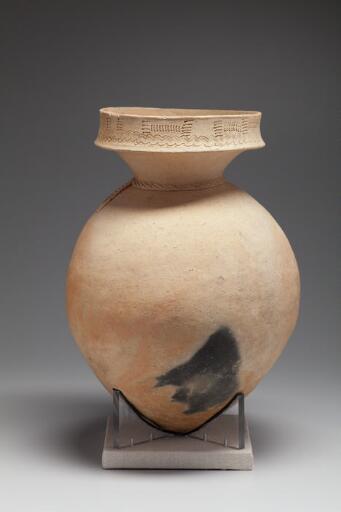
Ovoid Jar, c. A.D. 100
Japanese
The Yayoi culture of central Japan marked the fins identifiable influx of people from the Asian continent and witnessed the introduction of et-rice cultivation and bronze and iron metallurgy from Korea. Named after the site in Tokyo where this type of buff-colored pottery was first discovered, the Yayoi culture (c. 4th century BC-3rd century AD) also saw the beginnings of a settled, hierarchical society and a wealthy elite. Yayoi vessels reflect this society’s dependence on the cultivation of rice and the widespread use of storage jars for stockpiling reserves. Sturdier, more functional vessels with symmetrical, taut profiles and restrained embellishment replace the irregular shapes and exuberant decoration of the preceding Jomon-period wares.
This large Ovoid Jar is a particularly fine example of the fluid lines and uncluttered decoration that characterize the best of Yayoi pottery. The vessel was first shaped by hand and then finished on a wheel to produce thin, even walls and a balanced shape. The robust, swelling body, tapering to a point at its base; the simple, combed incisions on the lip; and the flat, braided cord around the neck are typical of the modest but bold decorative vocabulary of Yayoi potters.
(Michael Goedhuis, Ltd., Colnaghi Oriental, London);
purchased by Kimbell Art Foundation, Fort Worth, 1984.