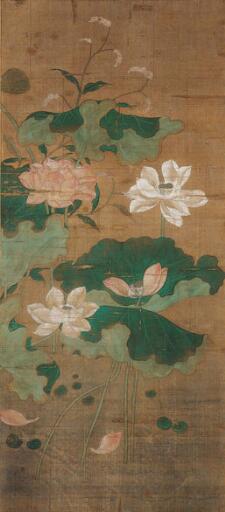
Pink and White Lotus, 14th century
Chinese
The grandeur of this depiction of lotus blossoms, leaves, and seed pods is eloquent testimony to the considerable position accorded the genre of flower painting in China. Produced for the court, flower paintings far exceeded other subjects—figures, Buddhist subjects, and landscapes—that are recorded in imperial collections. Practiced since the tenth century, the genre of flower painting reached its apogee in the late Song and Yuan dynasties.
This composition depicts the lotus at a moment just past its peak, when the blossoms are fully opened and some petals have begun to fall. The flowers retain their full colors, showing a gentle gradation of deep pink to nearly transparent lighter shades and white. The large, bowl-shaped leaves with lobed and curled edges are turned up to reveal a lighter shade of green on the underside. While the blossoms successfully convey lifelike qualities, the lotus in Asian art is never merely decorative but is a motif that has deep religious meaning. In Buddhism, the muddy pond in which the lotus grows represents the mundane world; the beautiful blossoms, which rise on stems high out of the water, represent the purity of salvation and rebirth in a heavenly paradise. Large-scale compositions of lotus were usually produced in pairs to decorate Buddhist temples or palace halls.
La grandiosidad de esta representación de las flores, las hojas y las vainas del loto es un testimonio elocuente de la considerable importancia otorgada a la pintura de flores en China. Producidas para la corte, las pinturas de flores superan por mucho a las pinturas de otras temáticas —como las figurativas, las budistas y los paisajes— que se registran en las colecciones imperiales. El género de la pintura de flores, practicado desde el siglo X, alcanzó su apogeo en las tardías dinastías Song y Yuan.
En esta composición se representa el loto en un momento apenas posterior a su punto de máximo desarrollo, cuando las flores están abiertas por completo y algunos pétalos han comenzado a desprenderse. Las flores retienen todo su color, mostrando una suave gradación desde un rosa intenso, pasando por tonos más claros casi trasparentes, hasta el blanco. Las grandes hojas cóncavas de bordes lobulados y curvados se dirigen hacia arriba, dejando ver un tono verde claro en la parte inferior. Mientras las flores presentan un aspecto muy realista, el loto en el arte asiático nunca es meramente decorativo, sino que es un motivo cargado de un profundo significado religioso. Para el budismo, los estanques enlodados en los que crece el loto representan el mundo terrenal; las bellas flores, que se elevan en sus tallos muy por encima del agua, representan la pureza de la salvación y el renacimiento en un paraíso celestial. Las composiciones de gran tamaño en las que aparece el loto se producían, por lo general, en pares para decorar los templos budistas o los corredores de un palacio.
(Alice Boney, New York);
purchased by Kimbell Art Foundation, Fort Worth, 1984.