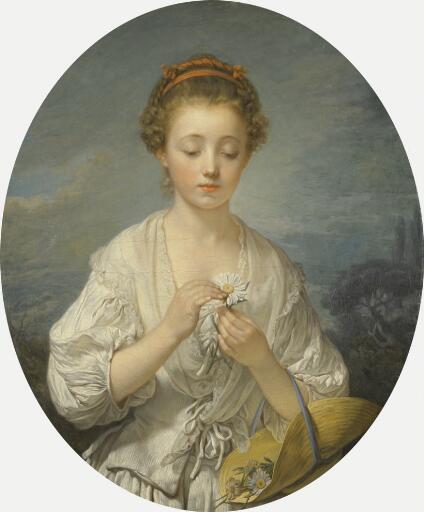
La Simplicité (Simplicity), 1759
Jean-Baptiste Greuze, French
Jean-Baptiste Greuze achieved fame for his morally uplifting multi-figure narrative paintings, but he was equally adept depicting single figures—usually young women or children—in a pastoral vein, as in La Simplicité. This painting shows a girl pulling petals off a daisy in a ritual of “he loves me, he loves me not.” Skillfully capturing the nuances of emotion at the dawning prospect of love, Greuze works within the oval shape of the canvas to lay stress upon the smooth curves of the girl’s face, brows, and hair ribbons, her straw hat, and cupped hands. The refinement of tones is seen in the transparency of the girl’s porcelain flesh, and the fluid brushwork of the creamy white costume, with its active play of delicate folds of fabric. The romantic sentiment and decorative style of La Simplicité are typical of French court painting of the ancien régime.
La Simplicité was once in the collection of Madame de Pompadour, the official chief mistress of King Louis XV. New research has determined that she received La Simplicité as a gift from her friend, Madame Marie Thérèse Geoffrin, who commissioned the painting and whose famous salon was a gathering place for leading intellectuals and artists of the French Enlightenment. Pompadour’s brother, the Marquis de Marigny, commissioned another painting from Greuze, Shepherd Holding a Flower (Petit Palais, Paris), as a pair to the Kimbell painting. To balance the narrative of La Simplicité, he painted a shepherd boy holding a fragile dandelion and pensively making a wish for his love to be reciprocated. Greuze received that commission a few years after painting La Simplicité but did not deliver it to Madame de Pompadour until 1761.
Adult: La Simplicité (Simplicity)
Adult: La Simplicité (Simplicity), Clothing
Marie Thérèse Rodet Geoffrin née Rodet [1699–1777], Paris, before November 1759;
given to Jeanne-Antoinette Poisson, marquise de Pompadour [1721–1764], Versailles, by November 1759;
by inheritance, with its pendant, The Young Shepherd, to her brother, Abel-François Poisson de Vandières, marquis de Marigny and Menars [1727–1781], Paris;
(his sale, Paris, 18 March–6 April 1782, no. 43);
purchased, with its pendant, for 2399 livres 19 sols by François-Antoine Robit [b. c. 1743/44].
Comte Hyacinthe-François-Joseph d'Espinoy [1764–1848], Paris;
(his sale, Versailles, 4–9 February 1850, no. 934);
purchased, with its pendant, no. 935, for 615 francs by “Ward”, possibly a dealer or agent.
Baron Édouard (Alphonse James) de Rothschild [1868–1949], Paris;
confiscated by Nazi forces; taken to the Jeu de Paume, Paris; removed to Alt Aussee, Austria;
recovered by allied forces and shipped to the Munich Central Collecting Point on June 29, 1945, and released from MCCP and shipped to France October 7, 1945;
returned to Rothschild family;
Baroness Édouard (Germaine Alice Halphen) de Rothschild [1884–1975], Paris;
Baron Edmond (Adolphe Maurice Jules Jacques) de Rothschild [1926–1997], Château de Prégny, Geneva, Switzerland;
purchased through (French & Company, Inc., New York) by the Kimbell Art Foundation, Fort Worth, 1985.