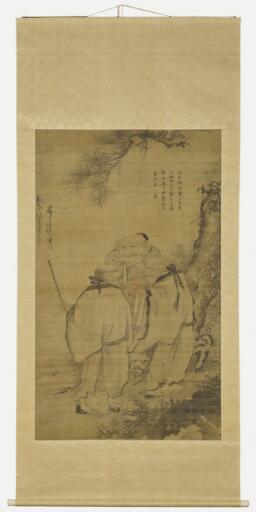
The Three Stars of Happiness, Wealth, and Longevity, c. 1500
Wang Zhao, Chinese
This bold and lively painting by the eccentric artist Wang Zhao depicts a trio of Taoist deities who are charged with caring for the well being of individuals. In popular legend each deity is derived from a historical person, and although grouped as a trio here, each is worshiped separately. The vigorous brushwork, notable in the strong outlines of the figures and in the trunk of the tree, is typical of the expressionistic style favored by Chan (Zen) priest-painters, which was particularly suited to Taoist divinities and themes.
The Star of Happiness (Fuxing) is generally associated with a sixth-century civil official who persuaded his emperor to release the dwarfs taken forcibly from his hometown to serve as entertainers at court. Fuxing is the figure at the center rear who wears the robes of a civil bureaucrat. The Star of Wealth (Luxing), pictured on the left, is personified by Shi Fen, a Chinese peasant who became a general and allied himself with the founder of the Han dynasty (206 B.C.–A.D. 220). As a reward for his conquests he received both honors and great wealth. The Star of Longevity (Shouxing) is a deity who fixes the time of death for each individual. His presence as a star was a sign of peace; his disappearance, a sign of war. Shouxing stands on the right and holds the peach of immortality in his hands.
En esta pintura alegre y llamativa del excéntrico artista Wang Zhao se representa a un trío de deidades taoístas a quienes se encomienda el cuidado del bienestar de las personas. Según la leyenda popular, cada deidad ha derivado de un personaje histórico y, aunque aquí se las agrupa en un trío, a cada una se le rinde culto por separado. La pincelada enérgica, visible en los fuertes contornos de las figuras y en el tronco del árbol, es típica del estilo expresionista preferido por los monjes pintores zen, que resultaba particularmente apropiado para la representación de divinidades y temáticas taoístas.
La estrella de la felicidad (Fuxing) suele asociarse a un funcionario del siglo VI que convenció al emperador de liberar a los enanos tomados a la fuerza de su ciudad natal para servir de entretenimiento en la corte. Fuxing es la figura del centro, que lleva la túnica de un funcionario público. La estrella de la abundancia (Luxing), a la izquierda, está encarnada por Shi Fen, un campesino chino que se convirtió en general y se alió con el fundador de la dinastía Han (206 a. C. – 220 d. C.). Como recompensa por sus conquistas recibió honores y grandes riquezas. La estrella de la longevidad (Shouxing) es una deidad que fija la hora de la muerte de cada persona. Su presencia como una estrella era símbolo de paz; su desaparición, símbolo de guerra. Shouxing se encuentra a la derecha, sosteniendo el durazno de la inmortalidad.
(Howard Rogers, Kamakura);
purchased by Kimbell Art Foundation, Fort Worth, 1985.