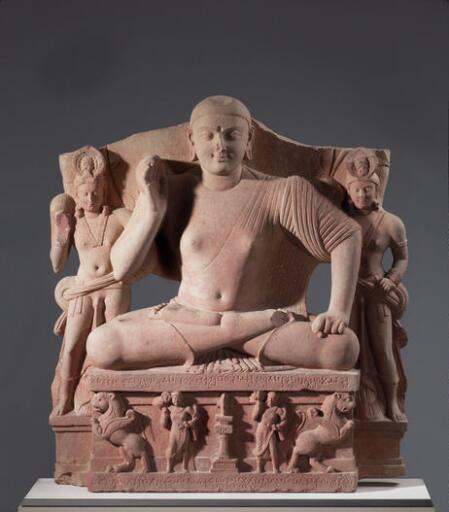
Seated Buddha with Two Attendants, c. A.D. 131
Indian
The Kushans ruled much of northwestern India and the ancient region of Gandhara (parts of present-day Pakistan and Afghanistan). Mathura was the second capital of the Kushans and a major center of art production, which developed there out of the indigenous Indian traditions, and made much use of the local mottled- red sandstone.
This seated Buddha conforms to a standard early Mathura type. In his personification as Shakyamuni, the teacher, the Buddha is portrayed as a traditional yogi, seated on a throne, and dressed as a monk. The thin, diaphanous robe is worn over the left shoulder, leaving the right shoulder bare. The sensitive modeling of the soft flesh gives little hint of the musculature underneath but still endows the body with a sense of solidity and mass. The hair is smooth like a cap, and the cranial bump (ushnisha), now missing, would have appeared as a twisted bun or coil of hair (kapardin). The right hand is raised in the gesture of reassurance (abhayamudra).
As prescribed by the scriptures, the palms of the hands and soles of the Buddha’s feet are marked with the lotus and the wheel, symbols of his divinity and teaching. Carved in high relief with generously modeled and sensuous torsos, the royal attendants flanking the Buddha have similar stylized facial features and archaic smiles as their lord. The sculpture is carved in the form of a stela and includes other symbols and figures referring to the Buddha’s life and exalted status as a universal monarch. The large halo behind his head represents the sun and proclaims his divinity. The pillar, topped by a wheel centered in the relief panel of the throne, is symbolic of preaching and refers to the Buddha’s first sermon at Sarnath. The two figures holding flywhisks, flanking the pillar, and the rampant lions signify the Buddha’s royal heritage.
Children's: Seated Buddha with Two Attendants
Adult: Seated Buddha with Two Attendants
Los Kushan dominaron gran parte del noroeste de la India y la antigua región de Gandhara (hoy parte de Pakistán y Afganistán). Mathura era la segunda capital del Imperio Kushan y un destacado centro de producción artística, que se desarrolló allí a partir de tradiciones indias autóctonas e hizo gran uso de la arenisca roja moteada del lugar.
Este Buda sentado se ajusta al estándar de los primeros años en Mathura. En su personificación como Shakyamuni, el maestro, el Buda se representa como un yogi tradicional, sentado en un trono y vestido de monje. La túnica ligera y diáfana se lleva sobre el hombro izquierdo, dejando el derecho al descubierto. El delicado modelado que se ha hecho de la piel suave deja muy pocos indicios de la musculatura, pero aun así le otorga al cuerpo una sensación de solidez y masa. El pelo tiene la apariencia suave de un gorro, y la protuberancia craneal (ushnisha) —hoy perdida— se habría asemejado a un moño plegado o un rollo de cabello (kapardin). El Buda tiene la mano levantada en gesto de seguridad y tranquilidad (abhayamudra).
Como prescriben las escrituras, las palmas de las manos y las plantas de los pies del Buda llevan las marcas del loto y la rueda, símbolos de su estatus divino y de la enseñanza. Tallados en alto relieve, con torsos sensuales y bien modelados, los ayudantes reales que flaquean al Buda tienen rasgos faciales estilizados y sonrisas arcaicas similares a las de su señor. Esculpida como una estela, la obra incluye otros símbolos y figuras que hacen referencia a la vida del Buda y a su elevado estatus como monarca universal. El gran halo que rodea su cabeza representa el sol y proclama la divinidad del Buda. El pilar, coronado con una rueda, que ocupa el centro del panel del trono, simboliza la predicación y se refiere al primer sermón del Buda en Sarnath. Las dos figuras que sostienen espantamoscas y flaquean el pilar, y los leones rampantes son símbolos de la herencia real del Buda.
Helen Schulz-Piroth, Germany, about 1958 to1978;
purchased by (Mansur Galleries, Ltd., London), 1978-80;
purchased by Michael Phillips, Beverly Hills, California, 1980-86;
purchased by Kimbell Art Foundation, Fort Worth, 1986.