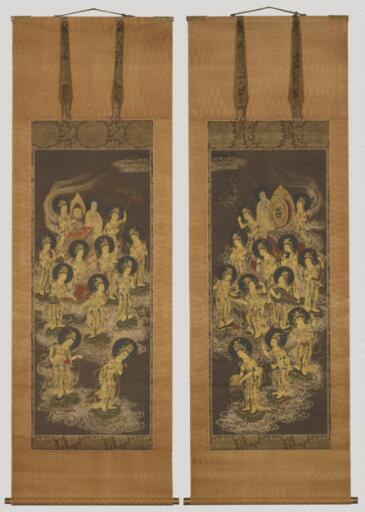
Twenty-Five Bodhisattvas Descending from Heaven, c. 1300
Japanese
In this pair of paintings, twenty-five small music-making divinities, bejeweled and richly dressed in gold, float down from the heavens on diaphanous clouds. The divinities are bodhisattva attendants to Amida Buddha, who inspired in his followers the hope of eternal life in his Western Paradise. The pair would originally have flanked a painted image of Amida Buddha. The two groups of divinities are led on the right scroll by the bodhisattva Kannon, who holds a small lotus pedestal to receive the soul of the deceased, and on the left by Seishi, whose hands are held in the anjalimudra, the gesture of respect and salutation. The rest of the entourage play drums, a lute, koto, and other stringed instruments, and stand and dance on lotus pedestals as they float down on clouds, their long scarves and jewels swaying as they move. The figures are outlined in ink, their features delineated with fine, delicate lines, and painted in gold, their garments executed in the painstaking kirikane technique of cut-and-pasted gold leaf.
This painting expresses belief in the compassionate grace of Amida, who grants salvation to any believer who sincerely calls upon his name, and who descends from heaven to personally receive the soul of the believer at the moment of death.
En este par de pinturas, veinticinco pequeñas divinidades tocando instrumentos, adornadas con joyas y suntuosamente vestidas de dorado, bajan flotando del cielo sobre nubes diáfanas. Se trata de los ayudantes bodhisattva del Buda Amida, quien inspiró en sus seguidores la esperanza de la vida eterna en su paraíso occidental. Este par de obras habría flanqueado originalmente a una imagen pintada del Buda Amida. Los dos grupos de divinidades se encuentran conducidos, en el rollo derecho, por el bodhisattva Kannon, quien sostiene un pequeño pedestal de loto para recibir las almas de los difuntos, y, en el izquierdo, por Seishi, cuyas manos hacen el gesto anjalimudraen símbolo de respeto y salutación. El resto del séquito toca tambores, un laúd, un koto y otros instrumentos de cuerda, y se encuentran de pie o bailando sobre pedestales de loto a medida que bajan flotando sobre nubes, con sus largos pañuelos y joyas meneándose junto con ellos. Las figuras, cuyo contorno se ha delineado en tinta, tienen el rostro pintado de dorado, trazado con líneas finas y delicadas, y sus atuendos se han ejecutado con la minuciosa técnica del kirikane, que implica cortar y pegar pan de oro.
Esta pintura expresa la creencia en la gracia compasiva de Amida, quien otorga la salvación a todo aquel creyente que invoque su nombre con sinceridad, y desciende del cielo en persona para recibir el alma de los fieles a su muerte.
(London Gallery, Ltd., Tokyo);
purchased by Kimbell Art Foundation, Fort Worth, 1986.