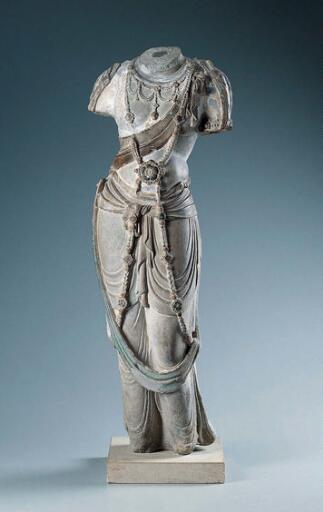
Bodhisattva Torso, c .A.D. 775–800
Chinese
The evolution of Chinese Buddhist sculpture from archaic and columnar to fleshy and sensuous reached its culmination in the Tang dynasty, by which time Chinese Buddhist sculpture in the round shows a masterful adaptation of foreign Indian style to indigenous traditions. The finest Tang sculptures are voluptuous and tactile, their sumptuous garments carved to accentuate the contours of the body, with flowing scarves and clinging ropes of beads to emphasize its curves.
This torso, adorned in a simple skirt with a scarf across the chest and a long, elaborate necklace, represents a bodhisattva attendant to the Buddha, one of a class of divine beings who put off their own final nirvana to help humankind on the path to enlightenment. The pronounced tribhanga pose, with the left knee slightly bent; the fleshy, volumetric treatment of the body; and the thin drapery reflect continuing Indian influence, here of the Gupta period (A.D. 320–600). The skirt, or dhoti, gathered and loosely tied at the waist, is sculpted into graceful folds and naturalistic curves that reinforce the sense of movement in the body. The necklace, crossed in front and looped around the sides to the back, is crisply carved with individual beads and studded with medallions. The torso is distinguished by its remarkably thick, full body when viewed from the side and by the sharp, precise quality of the carving.
La evolución de la escultura china budista, que pasó de arcaica y estática a carnosa y sensual, alcanzó su punto culminante en la dinastía Tang, momento en que la escultura budista de bulto redondo de la China muestra una adaptación magistral del estilo extranjero de la India a las tradiciones autóctonas. Las esculturas Tang de mayor calidad son voluptuosas y tangibles; los suntuosos atuendos, así como los fluidos pañuelos y collares de cuentas ceñidos al cuerpo, están tallados para acentuar las curvas.
Este torso, adornado con una simple falda y un pañuelo que cruza el pecho, junto con un largo y elaborado collar, representa a una ayudante bodhisattva de Buda, perteneciente a una clase de seres divinos que postergaban su propio nirvana para ayudar a la humanidad en su camino de iluminación. La pronunciada pose tribhanga—con la rodilla izquierda ligeramente flexionada, el tratamiento carnoso y volumétrico del cuerpo, y los delgados paños que lo cubren—refleja la continuación de la influencia india, en este caso del periodo Gupta (320–600 d. C.). La falda, o dhoti, recogida y atada holgadamente a la cintura, está esculpida formando elegantes pliegues y curvas naturales que refuerzan la sensación de movimiento del cuerpo. El collar, que se cruza al frente y se curva hacia atrás por los lados, tiene cuentas individuales y medallones incrustados tallados con esmero. El torso se distingue por la figura notablemente gruesa y carnosa, cuando se lo mira de lado, y por la calidad elegante y precisa de su tallado.
Patiño Collection, Bolivia, possibly by 1948;
(sale, Sotheby’s, New York, 3 December 1986, no. 280;
purchased by (Eskenazi, Ltd., London);
purchased by Kimbell Art Foundation, Fort Worth, 1987.