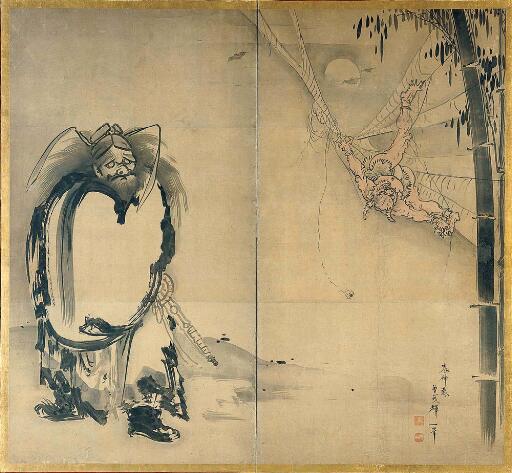
Shoki Ensnaring a Demon in a Spider Web, 18th century
Soga Shohaku, Japanese
Soga Shohaku was one of the Three Eccentrics of the Edo period (1615–1868). Accounts of Shohaku’s life are full of anecdotes about his bizarre behavior, and stories about him took on a legendary character. He enjoyed immense popularity in Japan during his lifetime, and his paintings were appreciated for their unconventional approach to classical subject matter.
Shoki, the subject of this painting, is the Japanese name of a Chinese popular hero, Zhong Kui, who lived in the seventh century. Unjustly defrauded of a first-rank grade in his civil examinations, Zhong Kui committed suicide on the steps of the imperial palace. The emperor then ordered that he be buried with high honors in a green robe reserved for the imperial family. Out of gratitude, Zhong Kui’s spirit dedicated itself to protecting the empire from demons.
Shoki the Demon Queller became a popular subject of Japanese painting in the Edo period, and Shohaku painted it in many versions, always with humor and imagination. Though executed in ink with strong and forceful strokes, his paintings are never extreme in their exaggerations but marked by a refinement of brushwork that lies at the core of his achievement.
El pintor Soga Shohaku fue uno de los Tres excéntricos del periodo Edo (1615–1868). Los recuentos de la vida de Shohaku están repletos de anécdotas sobre su extraño comportamiento, y las historias que protagonizaba adquirieron un carácter legendario. Gozó de una grandiosa popularidad en Japón en vida, y sus pinturas fueron muy valoradas por su original acercamiento a los temas clásicos.
Shoki, el sujeto de esta pintura, es el nombre japonés del héroe popular chino Zhong Kui, quien vivió en el siglo VII. Habiendo sido víctima de un fraude que le impidió superar los exámenes para convertirse en funcionario civil de primer rango, Zhong Kui se suicidó en las escalinatas del palacio imperial. Luego, el emperador ordenó que se lo enterrara con los más altos honores, vistiendo la túnica verde reservada para la familia imperial. En agradecimiento, el espíritu de Zhong Kui se dedicó a proteger al imperio contra los demonios.
Shoki, el domador de demonios, se convirtió en un tema muy recurrente en la pintura japonesa del periodo Edo, y Shohaku realizó muchas versiones, siempre con un toque de humor e imaginación. Pese a encontrarse ejecutadas en tinta, con pinceladas enérgicas y fuertes, sus pinturas no resultan extremadamente exageradas, sino que están marcadas por un refinado manejo del pincel, motivo principal de su éxito.
(Harry Packard, Kyoto);
purchased by Kimbell Art Foundation, Fort Worth, 1987.