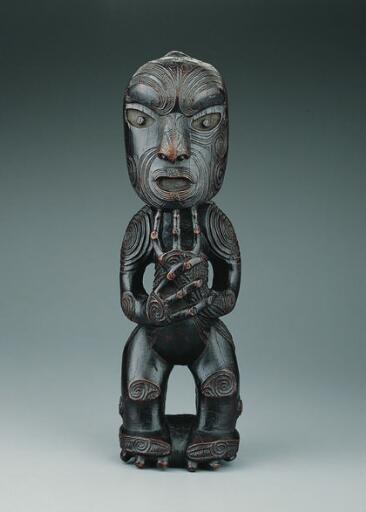
Standing Ancestor Figure, c. 1800–1840
Maori
The Maori tribes of New Zealand excelled in the decoration of their timber buildings with elaborate relief carvings and sculptures. This powerfully conceived, freestanding figure may have functioned as a tekoteko, a carved figure placed on the gable peak of an assembly house, food storehouse, or chief’s dwelling; or it may have been a poutokomanawa, the center post that holds up the ridgepole of a large house such as that of a chieftain. The ridgepole is symbolically the backbone of the ancestor who is represented by the house. The figure represents either a god or a recently deceased male ancestor who, in Maori culture, looks after the welfare of his descendants.
As is common with these statues, the face is carved with an intricate curvilinear pattern reproducing the tattoos (moko) that decorate the faces of Maori chieftains. The carvings on the arms are not the same tattoos as on the face; they are specific patterns that are either unique to a particular family (whanau) or have a specific significance for that sculpture. Spirals mark the joints of the figure at the shoulders, elbows, wrists, knees, and hips, reflecting the early date and superior quality of the work—the rough edges indicate that the spirals were cut with stone tools, before the introduction of steel knives in the early nineteenth century.
Adult: Standing Ancestor Figure
Las tribus maoríes de Nueva Zelanda se destacaban en la decoración de sus edificios de madera, que adornaban con tallados en relieve y esculturas. Esta figura de pie, concebida de modo impactante, puede haber funcionado como un tekoteko, figura tallada que se colocaba en el gablete de una casa de asambleas, un almacén de alimentos o en la vivienda de un jefe; o puede haber sido un poutokomanawa, el poste central que sostiene la parhilera de una casa grande, como la de un cacique. Simbólicamente, la parhilera es la columna vertebral del ancestro quien, en la cultura maorí, cuida del bienestar de sus descendientes.
Como suele ocurrir con estas estatuas, el rostro está tallado con un intrincado patrón curvilíneo que reproduce los tatuajes (moko) que decoran los rostros de los caciques maoríes. Los grabados de los brazos no son los mismos tatuajes que los de la cara: son patrones específicos que o bien son exclusivos de una familia (whanau) o bien son de especial importancia para esa escultura. Las articulaciones de la figura —hombros, codos, muñecas, rodillas y caderas— se encuentran marcadas con espirales, prueba de la antigüedad y la gran calidad de la obra. Los bordes desiguales indican que las espirales fueron grabadas con utensilios de piedra, previos a la introducción de los cuchillos de acero a principios del siglo XIX.
(Sotheby’s, London, 30 October 1987, no. 107);
purchased by (Wayne Heathcote Gallery, Belgium);
purchased by Morris J. Pinto;
(Ron Nasser, Inc., New York), 1987;
purchased by Kimbell Art Foundation, Fort Worth, 1989.