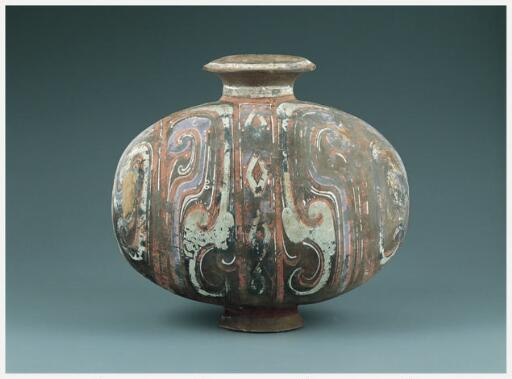
Cocoon-Shaped Jar with Cloud-Scroll Design, late 2nd or early 1st century B.C.
Chinese
This handsome jar would have served as a mortuary object (mingqi), placed in a tomb as a substitute for the more valuable bronze and lacquer vessels used in daily life. Along with a variety of other funerary earthenware objects, attendant figures, and animals, richly decorated vessels of this kind were intended to serve the spirit of the deceased in the afterlife.
The silk industry, dating back to the third millennium B.C., was a principal source of wealth for the Chinese economy during the Han dynasty. The distinctive, plump ovoid form of this jar imitates the silkworm’s cocoon. The drifting cloud-scroll (yunwen) motif, which flanks a central vertical panel of diamond-shaped lozenges, is evocative of the celestial realms of a Taoist immortal paradise. During the reign of the Han emperor Wudi (140–87 B.C.), fascination with the idea of the celestial journey and the Taoist search for immortality reached a climax and gave tangible definition to the ethereal decoration of painted earthenware vessels such as this.
Esta bella vasija habría servido como objeto funerario (mingqi), colocado en una tumba como sustituto de otras vasijas más valiosas, laqueadas o de bronce, que se utilizaban en la vida cotidiana. Junto con otros diversos objetos funerarios de barro cocido, sirvientes y animales, las vasijas lujosamente decoradas como esta tenían por objeto servir al espíritu del difunto en la otra vida.
La industria de la seda, que data del tercer milenio a. C., era una fuente primordial de riqueza para la economía china durante la dinastía Han. El característico formato ovoide y abultado de esta vasija imita la forma del capullo del gusano de seda. El motivo del roleo de nubes (yunwen), que flanquea un panel vertical de formas romboides ubicado en el centro, evoca los reinos celestiales de un paraíso inmortal taoísta. Durante el reinado de Wudi (140–87 d. C.), el emperador Han, la fascinación por la idea de un viaje celestial y la búsqueda taoísta de la inmortalidad alcanzó un punto culminante y le otorgó una definición tangible a la decoración etérea de las vasijas de barro cocido pintadas como esta.
(Haworth & Chen, Ltd., Hong Kong);
purchased by Kimbell Art Foundation, Fort Worth, 1995.