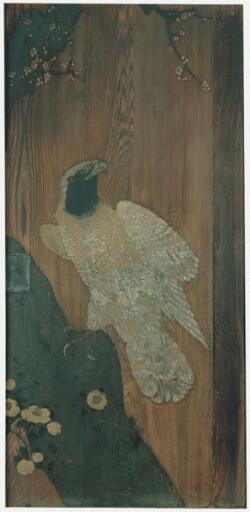
Sliding Door Panel with Design of Imperial Eagle, Plum Tree, and Camellia, first half of 17th century
Japanese
This sliding door panel, adorned with a majestic white eagle perched on a blossoming plum tree, is the right half of a two-panel sugito (cedar door). The motif of the eagle, like the hawk, was most likely a symbol of the samurai (warrior) class in Japan. The eagle represented on this door has been identified as an imperial eagle, a species that originated on the east coast of China and migrated to Japan as early as the fifteenth century. Plum blossoms are often paired with camellias to represent the rejuvenation that comes with the first signs of spring.
Beginning in the Momoyama period and continuing into the Edo period (1615–1868), painted doors were commonly installed in the magnificent castle residences of the wealthy daimyo (feudal lords) and powerful shogun (military overlords). Constructed from wood and decorated with painted designs, sometimes with gilt backgrounds, sugito served to brighten these dark, damp castle interiors. Birds of prey such as the eagle and the hawk were particularly popular subjects, represented in screens and on sliding doors, and were often paired with trees or flowers.
Este panel de puerta corrediza, adornado con una majestuosa águila blanca posada sobre un ciruelo en flor, es la parte derecha de una sugito (puerta de cedro) de dos paneles. Es muy probable que el motivo del águila, al igual que el del halcón, fuera un símbolo de la clase samurái (guerrera) de Japón. El águila representada en esta puerta ha sido identificada como un águila imperial, especie originaria de la costa este de China que ya en el siglo XV había migrado a Japón. La flor del ciruelo suele acompañarse de camelias como símbolo del rejuvenecimiento que llega con los primeros indicios de la primavera.
A partir del periodo Momoyama y durante todo el periodo Edo (1615–1868), las puertas pintadas se instalaron, por lo general, en los magníficos castillos que servían de residencia a los acaudalados daimio (señores feudales) y los poderosos shoguns (caudillos militares). Fabricadas en madera y decoradas con diseños pintados, a veces sobre fondos dorados, las sugito servían para alegrar el interior oscuro y húmedo de los castillos. Las aves de presa, como el águila y el halcón, eran temas especialmente populares que se representaban en pantallas y puertas corredizas, a menudo acompañadas de árboles o flores.
(R-L Sneider Inc., New York);
purchased by Kimbell Art Foundation, Fort Worth, 1995.