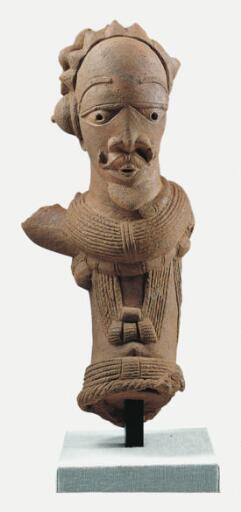
Male Figure, c. 195 B.C.–A.D. 205
Nok
Nok terracottas are the earliest known sculptures from ancient Nigeria. Sculptures of this kind were first discovered in 1943 by Bernard Fagg near the northern Nigerian village of Nok, after which the culture that produced them was named.
The highly skilled Nok artisans created images of great power, beauty, and sophistication. This commanding male figure represents the fully developed Nok style, characterized here by the expressively modeled head with finely detailed features—especially the lips, mouth, beard, and coiffure—and carefully defined costume. The complex hairstyle, characteristic of Nok pieces, is composed of three rows of seven conical buns, with larger hemispherical caps over the ears. The importance of jewelry in Nok culture is illustrated by the elaborate costume, here meticulously detailed and lavishly adorned with necklaces, jewelry, and beaded chains. The appearance of a horn, slung around the back of the shoulders, may identify the figure as a spiritual specialist (shaman). The figure is broken at the waistline, but may have originally been kneeling. Animated and compelling, this is one of the masterpieces of Nok sculptural art.
Las terracotas nok son las esculturas más vetustas que se conocen de la antigua Nigeria. Bernard Fagg descubrió este tipo de esculturas en 1943 cerca de Nok, pueblo del norte de Nigeria que dio nombre a la cultura que las produjo.
Los artesanos nok crearon, con grandiosa habilidad, imágenes de gran impacto, belleza y sofisticación. Esta imponente figura masculina representa el estilo nok en todo su esplendor, caracterizado aquí por esta cabeza expresivamente modelada, dotada de rasgos detallados con precisión —en especial, los labios, la boca, la barba y el peinado— y de un atuendo definido con esmero. El complejo peinado, característico de las piezas nok, está compuesto por tres hileras de siete moños, con unos sombreretes hemisféricos más grandes que cubren las orejas. La importancia de la joyería en la cultura nok se ilustra con el elaborado atuendo, lleno de detalles minuciosos y generosamente adornado con collares, joyas y cadenas de cuentas. La presencia de un cuerno, colgado en la espalda a la altura de los hombros, podría identificar a la figura como un especialista de la espiritualidad (un chamán). La figura se ha roto a la altura de la cintura, pero es posible que estuviera de rodillas. Animada y cautivadora, esta es una de las obras maestras del arte escultórico nok.
Private collection, Europe;
purchased by (L & R Entwistle & Co., Ltd., New York and London);
purchased by Kimbell Art Foundation, Fort Worth, 1996.