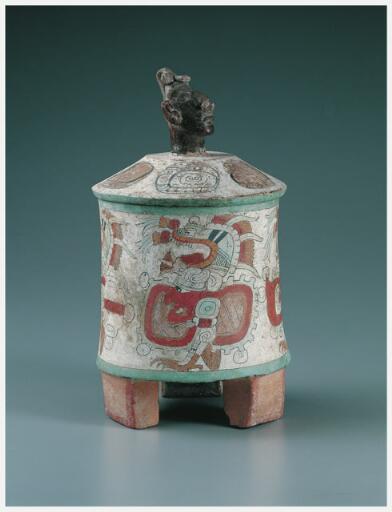
Tripod Vessel with Lid, c. A.D. 400–500
Maya
The art of the Maya is principally the art of the ruling elite. Vessels were made to honor and commemorate once-living rulers and to venerate their gods and ancestors; these objects, laden with power and symbolism, were then buried in tombs alongside their royal or noble owners. Much of the pottery found in Maya tombs was made especially to accompany the soul on its journey through the Underworld, Xibalba, a watery world that could be entered only by sinking beneath water or by passing through a maw in the surface of the earth. Funerary vessels of the Early Classic period (A.D. 250–600) often represented the watery surface of that Underworld and its inhabitants, shown either in narrative scenes or in processions.
The stuccoed body of this vessel is delicately painted with images of four chimerical creatures, each with a feathered, snakelike neck and head, a body containing the head of an aged divinity that may be Pawahtun (the god of the end of the year, and bearer of the sky and earth), spondylus shells for “wings,” and bird feet. Each figure is distinguished from the others by a different form of decorative “wing” and by colors that indicate its directional orientation. The cover is adorned with a small sculpted head, Maya in profile, having distinctive ear and nose plugs and an elaborate coiffure. The six glyphs on the cover represent a standard dedicatory verse found on ritual drinking vessels. The iconography, inscription, and very high quality of this vase all suggest that it was a ritual vessel containing the Maya chocolate drink, to be placed in the tomb of a nobleman.
El arte maya es, ante todo, el arte de la clase gobernante. Las vasijas se fabricaban para honrar y conmemorar a gobernantes pasados y para venerar a sus dioses y ancestros. Estos objetos, cargados de poder y simbolismo, se enterraban luego en las tumbas junto a los miembros de la realeza o los nobles a quienes pertenecían. Gran parte de las piezas de cerámica halladas en las tumbas mayas se fabricaron especialmente para acompañar al alma en su viaje por el Inframundo, Xibalba, mundo acuoso al cual solo podía accederse sumergiéndose en el agua o a través de las fauces abiertas en la superficie de la tierra. En las vasijas funerarias del periodo clásico temprano (250–600 d. C.) solía representarse la superficie acuosa del Inframundo y sus habitantes, tanto en escenas narrativas como en procesiones.
El cuerpo recubierto de estuco de esta vasija presenta cuatro imágenes quiméricas pintadas con delicadeza, que poseen un cuello y una cabeza con plumas similares a los de una serpiente, un cuerpo que contiene una divinidad anciana que podría ser Pawahtun (dios del fin de año y portador del cielo y de la tierra), “alas” de conchas de spondylus y pies de ave. Las figuras se distinguen entre sí por las distintas formas de “alas” decorativas que llevan y por los colores que indican su orientación. La tapa lleva una pequeña cabeza esculpida por adorno, de semblante maya, con distintivas dilataciones en la nariz y las orejas, y un elaborado peinado. Los seis glifos de la tapa representan un verso de dedicatoria hallado normalmente en las vasijas rituales para beber. La iconografía, la inscripción y la gran calidad de esta vasija sugieren que se trató de una vasija ritual que contenía la bebida de chocolate maya y que estaba destinada a colocarse en la tumba de un noble.
Herbert L. Lucas, Los Angeles, since the early 1970s;
(Ancient Art of the New World, New York);
purchased by Kimbell Art Foundation, Fort Worth, 1997.