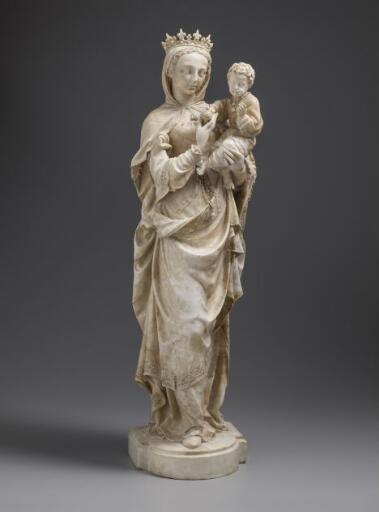
Virgin and Child, c. 1530– 35
Master from the Atelier de Saint-Léger, French, Troyes
In the aftermath of the Hundred Years’ War, fought between the French and English from 1337 to 1453, the city of Troyes in northeast France arose as a leading center for commerce. The nobles, church officials, and rich tradespeople of the city emerged as patrons of the arts, commissioning works of art—above all, sculpture—to adorn places of worship in Troyes and its environs. In the first decades of the sixteenth century, artists gathered from other locales, including from nearby Flanders, organizing into workshops to produce richly carved altarpieces or individual figure sculptures that reflected the stylistic change from the hierarchical formality of the Middle Ages to the graceful elegance of the Renaissance.
Today the statues made in Troyes in this period of effulgence are recognized as among the most beautiful to come from Renaissance France, yet the names of the artists who carved them are not always known. What we now call the “Atelier of Saint-Léger” was one of the workshops active in the 1520s and 1530s; a statue of the Virgin now in the church of Saint-Léger gives the workshop its name. Correspondences in the design, carving, and finish of the Saint- Léger Virgin and the Kimbell’s Virgin and Child suggest that they were made by the same artist or group of artists.
The Kimbell Virgin and Child is carved from alabaster, rather than from the local limestone of the Champagne region, allowing for the inclusion of unusually subtle details in the yard-high composition. The Virgin’s dress, for instance, is belted with a wide ribbon that falls in ripples over the folds of her mantle, beneath the precisely carved beads of a Rosary. The edges of the mantle, draped in heavy folds around the body, are adorned with rich embroideries described in shallow but clear-cut relief. In places, the master carver was able to thin the alabaster so that the folds of cloth are virtually transparent. This delicacy, enhanced by the traces of gold applied to the border of the mantle and to the curls of the Virgin’s hair, gives to the stone something of the precious luminosity of ivory. Together, these effects convey the vivid grace of the mother and her beloved child, who reaches out to touch the pomegranate she holds up—a symbol of his resurrection and everlasting life.
(Possibly with Levaillant, Paris, by 1900).
(Possibly with Fernand Robert through Friedrich Lippmann, Paris, by 1906).
Purchased by William Waldorf Astor, 1st Vicount Astor of Hever (1848–1919), Hever Castle, near Edenbridge, Kent, possibly from the above, by 1907;
his son Lieutenant-Colonel John Jacob Astor V, 1st Baron Astor of Hever (1886–1971), Hever Castle, near Edenbridge, Kent;
his son Gavin Astor, 2nd Baron Astor of Hever (1918–1984), Hever Castle, near Edenbridge, Kent;
(his sale Christie’s, London, 21 April 1982, lot 149);
private collection, United Kingdom;
(sale, Christie’s, London, 8 December 1987, lot 104);
private collection, United States;
(Stuart Lochhead Sculpture, London);
purchased by Kimbell Art Foundation, Fort Worth, 2022.