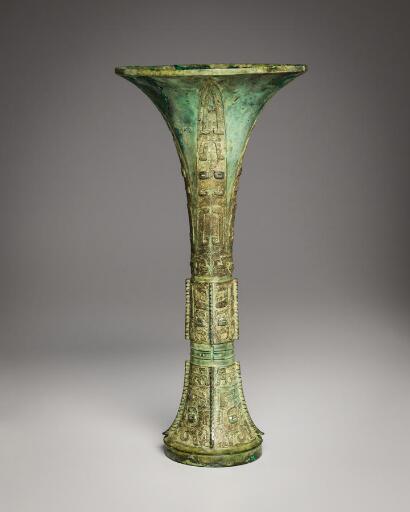
Gu Wine Vessel, c. 12th century B.C.
Chinese
In the late Shang dynasty, bronze vessels were used in state rituals concerned with communication with ancestors or gods. The belief that deceased spirits had powers to influence events on earth meant they had to be appeased. During periodic sacrifices, offerings of food and drink were made, and the spirits were invited to partake in a ritual meal. In addition to being used for ceremonies, bronze vessels were often buried in tombs with their owners. Among the various designs that decorate these vessels, the most distinctive and characteristic is the taotie. Typical features of this stylized animal-like mask include large protuberant eyes, eyebrows, horns, nose, ears, jaw, and clawed legs. These fantastic creatures, thought to symbolize spiritual power, may have served as intermediaries between the world of men and the realm of spirits.
With its taut and graceful silhouette, this elegant gu—a tall wine beaker with a trumpet-shaped mouth and a slightly flared base—is composed of three distinct vertical sections. The high-relief decoration is made up of varied taotie assembled from isolated raised elements covered with rounded spiral leiwen (thunder pattern) on a ground of squared spiral leiwen. The upper register is decorated with four crisply designed blade motifs tapering towards the lip, evoking cicadas as a symbol of regeneration, above a frieze of wiggling silkworms or serpents with bulging eyes. The central register and foot, each divided by four notched vertical flanges, also feature taotie and leiwen elements and a frieze of kui (one-legged dragons with curled snouts).
Durante el final de la dinastía Shang, las vasijas de bronce se utilizaban en ceremonias estatales para establecer comunicación con los ancestros o los dioses. La creencia de que los espíritus de los difuntos tenían el poder de influir en los eventos terrenales implicaba la necesidad de apaciguarlos. Durante los sacrificios periódicos, se presentaban ofrendas de comida y bebida, y se invitaba a los espíritus a participar en una comida ritual. Además de su uso ceremonial, las vasijas de bronce a menudo eran enterradas en tumbas junto con sus propietarios. Entre los diversos diseños que decoran estos recipientes, el más distintivo y característico es el taotie. Los rasgos representativos de esta máscara estilizada de aspecto animal incluyen ojos grandes y prominentes, cejas, cuernos, nariz, orejas, mandíbula y patas con garras. Estas criaturas fantásticas, consideradas símbolos de poder espiritual, podrían haber actuado como intermediarios entre el mundo humano y el reino espiritual.
Con su silueta tensa y elegante, este sofisticado gu —un largo vaso de vino con forma de trompeta en la parte superior y con una base ligeramente ensanchada— está estructurado en tres secciones verticales distintas. La decoración en altorrelieve está compuesta por varios taotie, ensamblados a partir de elementos elevados y aislados, cubiertos con un patrón redondeado de espirales leiwen (patrón del trueno), sobre un fondo de espirales cuadradas leiwen. La parte superior, presenta cuatro motivos de cuchillas diseñados con precisión que se estrechan hacia el borde, para evocar cigarras como símbolo de renovación, sobre un friso de gusanos de seda o serpientes retorciéndose con ojos prominentes. La parte central y la base, separadas por cuatro muescas verticales, también presentan elementos de taotie y leiwen, así como un friso de kui (dragones de una pata con el hocico enroscado).
In London by 1939;
(John Sparks Ltd., London) purchased by Wing Commander Lord Cunliffe [collection no. A26], November 19, 1946;
(sale, Bonhams, London, Fine Chinese Art Sale, Thursday 5 November, 2009, lot 3);
(Gisèle Croës, Art’s Extême d’Orient S. A., Brussels, Belgium) purchased by an American private collection, 2018;
(Gisèle Croës, Art’s Extême d’Orient S. A., Brussels Belgium) purchased by Kimbell Art Foundation, Fort Worth, 2022.