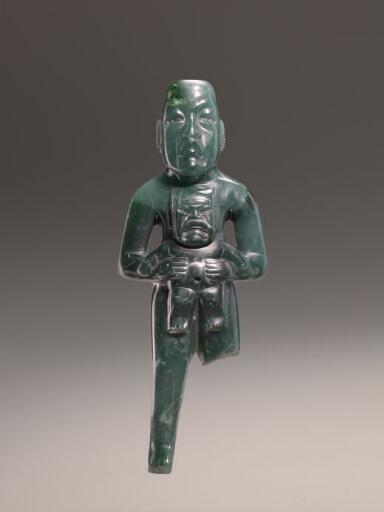
Standing Figure Holding a Were-Jaguar Baby, c. 900–300 B.C.
Olmec
The Olmecs were Mesoamerica’s mother culture and earliest civilization. In addition to hewing monumental stone sculpture and modeling animated figures in clay, Olmec lapidaries mastered the art of working hard stones to fashion exquisite figures, masks, celts, and personal ornaments for the ruling elite. Strongly anchored in the human form, Olmec style is also represented by composite supernatural creatures ranging from realistic to abstract.
This masterfully carved jade statuette depicts an unclothed, standing Olmec male figure, possibly a ruler, holding an infant were-jaguar, a supernatural creature that is part human and part jaguar. The baby displays the features typical of an Olmec were-jaguar: a V-shaped cleft in its head; slanted, almond-shaped eyes; a foreshortened, broad nose; and a fangless gaping mouth with downturned fleshy lips. A headband with two nodules and pleated ear ornaments at the sides link the were-jaguar baby with the Olmec Supernatural, one of the culture’s most important deities, who controlled the rain and the growth of maize. The physical association between the male figure and the supernatural being in this statuette would have validated the figure's authority, demonstrating his shamanic capabilities and access to the supernatural through ritual performances. Effigies such as this, carved from precious materials, were empowered objects and may have been animated in rituals or deposited in burials or caches with other magical objects in sacred precincts. The ruler’s missing left leg may have been broken in such a ritual.
In the ancient Mesoamerican world, jade was highly prized for its rich green color, which was closely associated with maize and the attendant ideas of sustenance, fertility, preciousness, and enduring life. The mirrorlike polish of the statuette’s surface is a hallmark of the most refined Olmec jade sculptures.
Los olmecas fueron la cultura madre y la primera civilización de Mesoamérica. Los lapidarios de la cultura olmeca no solo tallaban monumentales esculturas de piedra y modelaban figuras animadas en arcilla, sino que dominaban el arte de trabajar las piedras duras para elaborar exquisitas figuras, máscaras, herramientas y ornamentos personales para la élite gobernante.
Esta estatuilla de jade tallada magistralmente, famosa hace muchos años entre los estudiosos de las civilizaciones mesoamericanas por considerarla un referente del arte olmeca, representa una figura masculina olmeca de pie y desnuda —posiblemente un gobernante— que sostiene a un bebé hombre-jaguar: una criatura sobrenatural que es mitad humana, mitad jaguar. El bebé exhibe los rasgos característicos de un hombre-jaguar olmeca: cabeza con una hendidura en forma de “V”, ojos rasgados y almendrados, nariz ancha y acortada, boca abierta y sin colmillos con labios voluptuosos y hacia abajo. La vincha con dos nódulos y ornamentos plisados en las orejas a ambos lados asocian al bebé-jaguar con el “Sobrenatural Olmeca”, una de las deidades más importantes de la cultura, que controlaba la lluvia y el crecimiento del maíz. La asociación física entre la figura masculina y el ser sobrenatural que refleja esta estatuilla habría validado la autoridad de la figura, lo cual demostraría sus capacidades chamánicas y su acceso al mundo sobrenatural mediante prácticas ritualistas. Esta clase de efigies, talladas en materiales preciosos, eran objetos de poder y podían animarse en rituales, enterrarse en inhumaciones, o bien depositarse junto con otros objetos mágicos en recintos sagrados. Es posible que la pierna izquierda que le falta al gobernante se haya roto durante un ritual.
En el antiguo mundo mesoamericano, el jade era una piedra muy preciada por su intenso color verde, estrechamente asociado con el maíz y las ideas de sustento, fertilidad, valor inapreciable y vida prolongada. El pulido con acabado espejo que exhibe la superficie de la estatuilla es un sello distintivo de las esculturas olmecas más refinadas hechas en jade.
With Manuel de Posada y Garduño (1780–1846), Mexico City, by 1829.
Reputedly acquired by Prosper de Chasseloup-Laubat, 4th Marquis of Chasseloup-Laubat, (1805–1873) Paris, France;
by descent, Chasseloup-Laubat family.
(Robert Rousset (1901–1981), Paris and New York, acquired by 1947);
purchased by Alastair Bradley Martin (1915–2010) and Edith Park Martin (1916–1989), New York (The Guennol Collection), 1947;
his son Robin Bradley Martin (1949–2019), Palm Beach, Florida; Washington, DC; Paris, 1970;
Robin B. Martin Trust, 2010.
purchased by Kimbell Art Foundation, Fort Worth, 2023