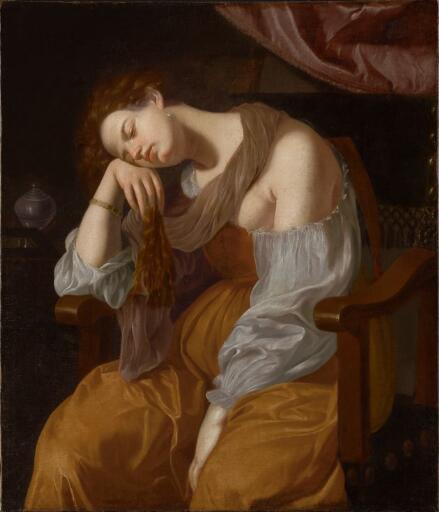
Penitent Mary Magdalene, 1625–26
Artemisia Gentileschi, Italian
Artemisia Gentileschi, one of the most important and accomplished seventeenth-century Italian painters, was an iconic model of perseverance, resolve, and achievement despite the numerous obstacles she faced as a woman. Trained in Rome in the studio of her father, Orazio Gentileschi, a friend and follower of Caravaggio, the indomitable Artemisia tenaciously pursued her professional ambitions on her own terms.
Like Caravaggio, Artemisia painted Mary Magdalene many times, creating fresh expressions of the saint’s spirituality through deft use of light and shadow and intense physicality. Here, Mary Magdalene closes her eyes, fingering a cascade of auburn hair. In the shadows at left, an ointment jar and a small mirror lay flat on a table. These discarded items, along with her bracelet and pearl earring, identify her as Saint Mary Magdalene, who has renounced her former life of luxury and vanity and closes her eyes to reflect on her sinful past, vowing her devotion to Christ.
Oblivious to her appearance, she enters a spiritual realm. The sensuality of Artemisia’s painting not only conveys the story of Mary Magdalene but also exploits the power of art to connect intimately with the viewer. In contrast to some of her more violent narratives of forceful, heroic women, such as Judith and Lucretia, Artemisia’s Magdalene captures an introspective moment of contrition and reflection, intense in its spiritual power.
This painting was acquired by Fernando Enríquez Afán de Ribera, the third Duke of Alcalá and later Viceroy of Naples, when serving as ambassador in Rome (1625–26). Later displayed in his residence in Seville, the Penitent Mary Magdalene was widely copied. The original painting, however, disappeared until recently, when it was rediscovered in exceptional condition.
Artemisia Gentileschi, una de las pintoras italianas más importantes y consumadas del siglo XVII, fue un modelo emblemático de perseverancia, determinación y éxito a pesar de los numerosos obstáculos a los que se enfrentó como mujer. Formada en Roma en el taller de su padre, Orazio Gentileschi, amigo y seguidor de Caravaggio, la indomable Artemisia persiguió con tenacidad sus ambiciones profesionales en sus propios términos.
Al igual que Caravaggio, Artemisia pintó a María Magdalena en numerosas ocasiones, creando nuevas expresiones de la espiritualidad de la santa mediante un diestro uso de la luz y la sombra y una intensa presencia física. Aquí, María Magdalena cierra los ojos y pasa los dedos por una cascada de cabello castaño rojizo. En las sombras, a la izquierda, un frasco de ungüento y un pequeño espejo están apoyados sobre una mesa. Estos objetos posados allí con descuido, junto con su pulsera y su pendiente de perlas, la identifican como Santa María Magdalena, quien ha renunciado a su antigua vida de lujo y vanidad y cierra los ojos para reflexionar sobre su pasado pecaminoso, consagrándose a Cristo.
Indiferente a su apariencia, entra en un reino espiritual. La sensualidad de la pintura de Artemisia no solo transmite la historia de María Magdalena, sino que también aprovecha el poder del arte para establecer una conexión íntima con el espectador. A diferencia de algunas de sus narraciones más violentas sobre mujeres fuertes y heroicas, como Judit y Lucrecia, la Magdalena de Artemisia captura un momento introspectivo de arrepentimiento y reflexión, de gran intensidad espiritual.
Esta pintura fue adquirida por Fernando Enríquez Afán de Ribera, tercer duque de Alcalá y luego virrey de Nápoles, cuando era embajador en Roma (1625-26). María Magdalena penitente se expuso más tarde en su residencia de Sevilla y se copió muchísimas veces. La pintura original, sin embargo, desapareció hasta hace poco, cuando fue redescubierta en condiciones excepcionales.
Acquired by Fernando Enríquez Afán de Ribera, the third Duke of Alcalá and Viceroy of Naples (1583–1637), Rome and Casa de Pilatos, Seville, by 1626;
by inheritance to his heirs;
purchased by his heir, Antonio Juan de la Cerda seventh Duke of Medinaceli (1607–1671), Seville, in 1639.
(Tajan, Paris, Tableaux Anciens, sale 19 December 2001, lot no. 7) as “atelier of Artemisia Gentileschi”;
purchased by Nelson Shanks (1937–2015), Andalusia, Pennsylvania;
by inheritance to his heirs;
(purchased by Adam Williams Fine Art, Ltd., New York, 2024);
purchased by Kimbell Art Foundation, Fort Worth, 2024.