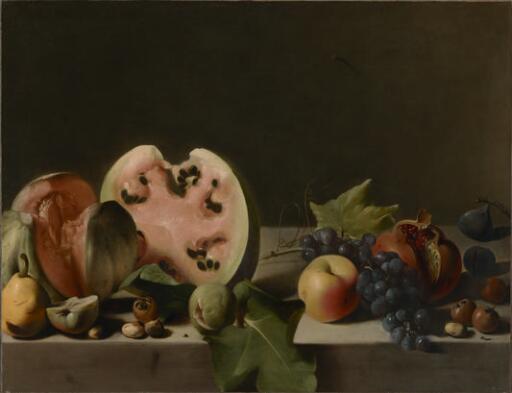
Still Life with Melon, Watermelon and Other Fruits, c. 1610–20
Pensionante del Saraceni, Italian
This quiet yet powerful painting is among the finest and earliest of the independent still lifes painted in Italy in the wake of Caravaggio, whose bold realism transformed the genre. The composition presents two groups of rounded fruits, fully ripe and ready to be eaten, balancing their varied contours and volumes. Soft light reveals each fruit’s texture and color: the dappled skin of a green pear, a succulent orange cantaloupe, moist pink watermelon flesh, a waxy red and yellow apple, a cluster of dark blue grapes, and a leathery pomegranate with seeds like garnets.
The artist’s sophistication is evident in the tight framing of the composition, which barely crops the arrangement of fruits at either side. Curled leaves and grape tendrils, along with smaller fruits and scattered seeds strewn across the picture, enhance the feeling of closeness and tangibility. What at first seems to be distant darkness beyond the stone tabletop suddenly comes into focus as a nearby wall—when the viewer notices an inconspicuous nail casting a soft shadow.
Given the extremely high quality of the painting, it is surprising that we cannot put a name to its maker. We believe that it was painted by an artist that historians have nicknamed the “Pensionante del Saraceni”—referring to someone who lodged with Carlo Saraceni, a Venetian painter working in Rome. The so-called Pensionante was probably Italian, though some historians have wondered whether he might be French or even Netherlandish; he is associated with a small group of paintings created in Rome around 1610–20, shortly after the death of Caravaggio.
Esta pintura, serena y a la vez poderosa, se encuentra entre los mejores y más tempranos bodegones independientes pintados en Italia siguiendo el estilo de Caravaggio, cuyo audaz realismo transformó el género. La composición presenta dos grupos de frutas redondeadas, completamente maduras y listas para su consumo, equilibrando sus diversos contornos y volúmenes. La luz suave revela la textura y el color de cada fruta: la moteada piel de una pera verde, un suculento melón anaranjado, la pulpa rosada y húmeda de una sandía, una manzana roja y amarilla de aspecto satinado, un racimo de uvas de color azul oscuro y una granada de piel coriácea con semillas como granates.
La sofisticación del artista se hace evidente en el encuadre apretado de la composición, que apenas recorta la disposición de las frutas a ambos lados. Las hojas enroscadas y los zarcillos de la vid, junto con los frutos más pequeños y las semillas esparcidas por toda la pintura, realzan la sensación de cercanía y tangibilidad. Lo que al principio parece ser una oscuridad que se pierde más allá de la mesa de piedra, de repente cobra nitidez y se convierte en una pared cercana cuando el espectador se fija en un clavo discreto que proyecta una suave sombra.
Dada la altísima calidad de la pintura, resulta sorprendente que no podamos identificar a su autor. Creemos que fue pintada por un artista al que los historiadores han apodado “Pensionante del Saraceni”, en referencia a alguien que se alojaba con Carlo Saraceni, un pintor veneciano que trabajaba en Roma. El llamado Pensionante era probablemente italiano, aunque algunos historiadores se han preguntado si podría ser francés o incluso neerlandés; se lo asocia con un pequeño grupo de pinturas creadas en Roma alrededor de 1610-20, poco después de la muerte de Caravaggio.
(Anonymous sale, Hôtel des Ventes Pasteur, Antibes, 5 November 1988, no. 134, as Spanish school, 17th century);
acquired by Jean Gismondi [1940–2014], Paris;
his heirs, Paris;
(Artcurial, Paris, Maîtres anciens & du XIXe siècles, 22 March 2023, lot 51, withdrawn);
private collection, Paris;
(with Nicholas Hall, New York, 2024);
purchased by Kimbell Art Foundation, Fort Worth, 2025.