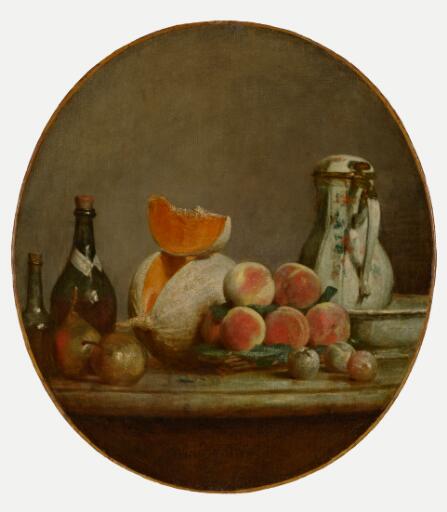
The Cut Melon, 1760
Jean Siméon Chardin, French
Chardin is considered one of the greatest painters of still lifes in the history of art. The Cut Melon has long been recognized as one of the artist’s most remarkable works, representing the highpoint of his mastery of volume, color, and light. The distinctive oval canvas amplifies the rounded shapes within the composition, in which a bright orange piece of cantaloupe balances atop the melon from which it has been sliced. Rigorously structured, with carefully manipulated textured brushstrokes and subtle pigments, the composition nonetheless seems effortless and unstudied. With its beautifully balanced palette and ineffable technique, it calls to mind the words of Chardin’s astonished admirer Denis Diderot: “Such magic cannot be fathomed.”
In The Cut Melon, Chardin gives the painting’s elements the sense of volume and weight, but also an impression of lively buoyancy. Each object invites touch—sleek glass bottles, shiny pears and plums, the rough-skinned but luscious melon, and velvety peaches rendered in shades of yellow, pink, and red. The handle of the ceramic pitcher anchoring the composition at right is positioned toward the viewer, as if to be grasped.
The canvas was paired with another oval, The Jar of Apricots (1758, The Art Gallery of Ontario, Toronto), in the collection of Jacques Roëttiers, a famous silversmith, who lent them both to the annual Paris Salon in 1761. It was bought in the early nineteenth century by the painter François Marcille, who assembled a renowned collection of eighteenth-century French paintings, contributing to the revival of interest in Chardin and other artists. From his son Camille, The Cut Melon was purchased in 1876 by Baroness Charlotte de Rothschild, an arts patron and gifted watercolor painter, in whose family it remained until acquired by the Kimbell Art Foundation.
Jacques Roëttiers [1707–1784], Paris, by 1761 (with its pendant, The Jar of Apricots);
by descent to his son, Alexandre-Louis Roëtiers de Montaleau [1748–1808], Paris, (with its pendant, The Jar of Apricots), 1784;
(anonymous sale, Catalogue de Tableaux, Paillet and Delaroche, Paris, 19 July 1802 (30 Messidor an 10, 1st day of sale), lot no. 25 (with its pendant, The Jar of Apricots);
purchased by Guillaume-Jean Constantin [1755–1816], 1802 (with its pendant, The Jar of Apricots);
possibly by descent to his son, Amédée Constantin [1795–1836] (with its pendant, The Jar of Apricots), Paris, 1816.
Purchased by François-Martial Marcille [1790–1856], Paris, probably from the Constantin family, between 1816 and 1830 (with its pendant, The Jar of Apricots);
by descent to his son, Camille Marcille [1816–1875], Paris, 1856 (with its pendant, The Jar of Apricots);
(his posthumous sale, hôtel Drouot, Paris, 6–7 March 1876, lot no. 16);
(purchased by Stéphane Bourgeois [1838 or 1839–1899], Cologne), on behalf of the Baroness Charlotte de Rothschild [1825–1899], widow of Baron Nathaniel de Rothschild [1812–1870] Paris, 1876;
by descent to her grandson, Baron Henri James Nathaniel de Rothschild [1872–1947] Paris, 1899;
by descent to his heirs, 1947;
(Christie’s sale, Paris, 12 June 2024, lot no. 5; purchaser failed to complete sale);
returned to above owners;
purchased by Kimbell Art Foundation, Fort Worth, 2025.