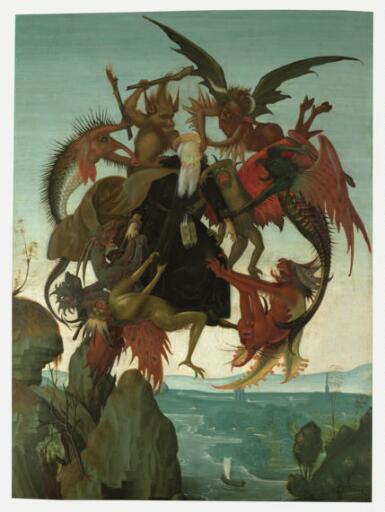
The Torment of Saint Anthony, 1487
Michelangelo Buonarroti, Italian
This is the first known painting by Michelangelo, created when the artist was twelve years old. The work’s subject is found in the life of Saint Anthony the Great, written by Athanasius of Alexandria in the fourth century, which describes how the Egyptian hermit-saint had a vision that he levitated into the air and was attacked by demons, whose torments he withstood. The painting is described in detail by Michelangelo’s contemporary biographers—Giorgio Vasari in his Lives of the Artists and Ascanio Condivi, whose Life of Michelangelo was overseen by the artist himself. The historian and poet Benedetto Varchi even discussed the painting in Michelangelo’s funeral oration.
Although Michelangelo considered himself first and foremost a sculptor, he received his earliest training as a painter in the workshop of Florence’s leading master Domenico Ghirlandaio (c. 1449–1494). Vasari and Condivi state that while Michelangelo was in the studio of Ghirlandaio, his first work, aside from some drawings, was a painted copy of the engraving Saint Anthony Tormented by Demons by the fifteenth-century German master Martin Schongauer and that this painting earned Michelangelo widespread recognition. The panel had special significance for Michelangelo and his biographers as testimony of his alleged divine genius, with Nature as his guide.
Michelangelo made several changes to Schongauer’s engraving that display his refined skill and quest for naturalism. He subtly revised the compositional vortex by making it more compact and adjusting the positioning and contours of bodies, limbs, and objects—a meticulous approach that shows his sensitivity to negative space and movement. He added a landscape that resembles not Egypt, where Saint Anthony the Great lived, but the Arno River Valley around Florence, which was the only landscape that the young Michelangelo knew.
Vasari and Condivi recount that to make the demons in the painting appear more lifelike, Michelangelo went to the fish market to observe the coloring, scales, and other parts of specimens. This study is reflected in the addition of scales to the spiny monster on the left—absent in the engraving—and the coloring of the demon on the right.
Condivi—speaking for Michelangelo himself in what was essentially an authorized biography—insists that an older artist friend, Francesco Granacci, rather than Ghirlandaio, supplied Michelangelo with the print, paint, and brushes. Ghirlandaio was jealous, Condivi asserted, and falsely tried to claim that the painting came from his workshop.
The artist’s preparatory underdrawing of the composition beneath the painted surface, invisible to the naked eye, is revealed with infrared reflectography (IRR) imaging. This underdrawing closely aligns with Schongauer’s print and does not reflect pentimenti, or changes made to the composition, which Michelangelo finessed in the final painting. Also beneath the painted surface is a brush-drawn doodle on the lower part of the panel that was not decipherable until 2015, when the more recent technology of hyperspectral imaging was able to capture legible images of the drawing. The coffered ceiling, a platform bed with a rectangular headboard surmounted by a small still life, and several figures identify it as a sketch of the Birth of the Baptist,, a fresco in the Tornabuoni Chapel in the church of Santa Maria Novella in Florence painted by Domenico Ghirlandaio’s team. This fresco is securely dated to the fall of 1487, thus confirming the date when Michelangelo is said to have painted The Torment of Saint Anthony, while associated with the Ghirlandaio workshop.
The Torment of Saint Anthony, is one of only four easel paintings generally regarded as having come from Michelangelo's hand and is the only painting by Michelangelo in an American collection.
Children's: Torment of Saint Anthony
Adult: The Torment of Saint Anthony
Adult: The Torment of Saint Anthony, Attribution
Children's: Torment of Saint Anthony, Original Saint Anthony Etching
Scorzi collection, Pisa, 1830s;
from which acquired by Baron Henry de Triqueti [1803-1874], Paris, probably in 1837;
his daughter, Mrs. Edward Lee Childe [1837-1886], (née Blanche de Triqueti), Paris;
(her deceased sale, Catalogue de tableaux oeuvres remarquables de la renaissance. . .provenant de la Collection de M. le baron de Triqueti, Paris, Hôtel Drouot, 4 May 1886, no. 5, bought in);
her husband, Mr. Edward Lee Childe, Paris and Château de Varennes, near Montargis, Loiret [1836-1911];
given to Sir Paul Harvey [1869-1948], London and Sussex, before 1905;
his widow, Ethel Frances Persse Harvey, [died 1966];
given to a friend, United Kingdom;
(Anonymous sale (“The Property of a Lady”), Catalogue of Important Old Master Paintings, London, Sotheby & Co., 7 December 1960, no. 17, unsold (as by Michelangelo));
her son, United Kingdom;
(Anonymous sale (“The Property of a Gentleman”), Catalogue of Old Master Paintings, Evening Sale, London, Sotheby's, 9 July 2008, no. 69, (as Workshop of Domenico Ghirlandaio));
(purchased by Adam Williams Fine Art Ltd, New York);
purchased by Kimbell Art Foundation, Fort Worth, 2009.